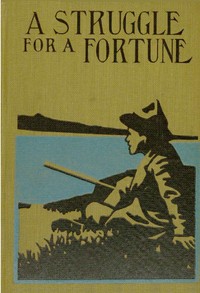
A Struggle for a Fortune by Harry Castlemon
I found this book buried in my grandmother’s attic, and honestly, it’s a gem of pure golden-age storytelling. A Struggle for a Fortune by Harry Castlemon (who, trivia alert, using his real name Charles Austin Fosdick wrote this in the 1890s) gives you the kind of adventure you’d have loved as a kid.
The Story
David Morris, an honest-and-hardworking boy, gets a tip from a mysterious hunter: an enormous fortune in coin was stashed in the deep woods near his frontier farm, tied to an old legend. The only clues? A rough map and a cryptic message. Soon, David sneaks off to dig for the gold. That sounds simple, right? But the excitement catches quickly—his greedy neighbor Slater gets wind of it and tries to claim the treasure through a legal twist. Then David’s dog unearths something unexpected in a lightning storm, adding real danger and discovery. Through it all, Castlemon takes you briskly across creeks, into caves, and over log bridges, with brief moments of pure terror when someone grips his shoulder in total darkness. Who is the path a friend or foe?
Why You Should Read It
What got me (and maybe this is a history-nerd confession) was the snapshots of mid-1800s small-town life—sleeping on pallets in a barn, bartering with woodpeck for eggs, seeing a preacher from a tent revival. The treasure hunt is simple and direct, no gadgets, just guts and rural hard work. Castlemon doesn’t shy from letting young David struggle genuinely: his mom sewing scratchy jeans, chores before and after the adventure. If you’re tired of oh-so-urban titles, this stubble-streaked world is fresh air. The language is old-fashioned in a cozy way (“I wouldn’t trade it for a dozen such tales”), not hard at all. You root for David completely.
Final Verdict
This is for anyone who likes a straightforward old-school bounty story, maybe parents reading adventure-aloud with tweens, or frontier-lit fans who devour everything about life near a town a generation past. Think like a clean Huck Finn or a simpler Stephenson. No toxic cynicism here—just David digging for fortune and finding himself (is how your modern blurb would say). Seriously? I spent a whole cloudy Sunday inside and loved every word.
This is a copyright-free edition. You do not need permission to reproduce this work.