
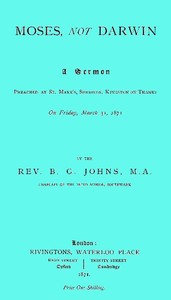
Moses, not Darwin by B. G. Johns
I picked up *Moses, not Darwin* thinking it would be some dusty, preachy rant. But boy was I wrong. B. G. Johns writes like he’s sitting across from you at a coffee shop, energized and ready to argue. His main point? That Darwin’s natural selection just can’t hold a candle to the poetic, purposeful story in Genesis. And the book itself feels brand new, even though it’s over 150 years old, because this science vs. faith tension still hums under everything we talk about today.
The Story
There’s no classic plot here — this isn’t a novel with characters you’ll fall in love with. Instead, the “plot” is the evolution of an idea: Johns takes you by the hand through what he sees as the holes in Darwin’s logic, especially where it comes to how complex life just popped into existence. He pulls out analogies like a watch needing a watchmaker, and his big move is to insist that Moses’ account of creation is actually just as reasonable as Darwin’s chain of cells — maybe more so because it leaves room for a purpose. It’s a blunt attack on what appeared at the time to be an unshakable new dogma, and sometimes he just sounds angry, but you can feel his sincerity.
Why You Should Read It
Voice and Vexation: You don't get this level of genuine, gripping debate in modern science writings — too polite! Johns has this charm to his anger that’s both annoying and refreshing. I found myself smiling at points and wondering already while planning my rebuttals. The passion wakes you up from any idea that intellectual fights have changed much since electricity became common streetlighting.
The Context Is Gold: He exposes an anxiety we’ve largely forgotten — that science could crush purpose from the world. The doubt knits through every page, and at its core is not geology, but hope. Rare for anything that mentions turtles from ancient oceans.
Final Verdict
I’d hand *Moses, not Darwin* to anyone half-interested in how we got where we are — culturally fighting science with sound bites. It’s worth it purely as a historical hand grenade from the siege walls of belief. Just know: fair warning, you’ll scribble notes in the margins, flame the living room with your thoughts later, then possibly wave the book at your uncle over Thanksgiving leftovers. So choose wisely, after asking yourself: are you up for being lit on fire by arguments 150 years dormant?
This digital edition is based on a public domain text. You can copy, modify, and distribute it freely.
Jessica Miller
1 month agoAs a professional in this niche, the author doesn't just scratch the surface but goes into meaningful detail. Highly recommended for those seeking credible information.
Nancy Rodriguez
9 months agoInitially, I was looking for a specific answer, but the practical checklists included are a great touch for real-world use. Definitely a five-star contribution to the field.
James Gonzalez
10 months agoI appreciate the objective tone and the evidence-based approach.
Nancy Lee
6 months agoI appreciate how this edition approaches the core problem, the insights into future trends are particularly thought-provoking. This adds significant depth to my understanding of the field.


Christopher Taylor
1 month agoThe clarity of the concluding remarks is very professional.