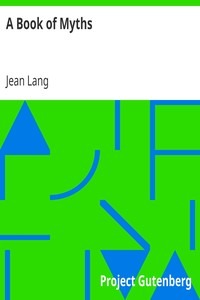
A Book of Myths by Jean Lang

(11 User reviews)   4507
By Jacob Brown Posted on Dec 22, 2025
In Category - Alien Worlds
Lang, Jean, 1867-1932 Lang, Jean, 1867-1932
English
Hey, have you ever wondered where all those old stories about gods, heroes, and monsters actually come from? Jean Lang's 'A Book of Myths' is like having a brilliant, patient friend walk you through the ancient tales that shaped our world. It's not just a list of myths—it’s a look at the people who told them and why these stories mattered so much. Lang connects the dots between different cultures, showing how a Greek legend might have a cousin in a Norse saga. If you've ever felt like mythology is a confusing web of strange names, this book is your clear, friendly guide.
Share

Read "A Book of Myths by Jean Lang" Online

This book is available in the public domain. Start reading the digital edition below.

START READING FULL BOOK
Instant Access    Mobile Friendly

Book Preview

A short preview of the book’s content is shown below to give you an idea of its style and themes.

the student of folklore as a fresh contribution to his knowledge. Rather is the book intended for those who, in the course of their reading, frequently come across names which possess for them no meaning, and who care to read some old stories, through which runs the same humanity that their own hearts know. For although the old worship has passed away, it is almost impossible for us to open a book that does not contain some mention of the gods of long ago. In our childhood we are given copies of Kingsley's _Heroes_ and of Hawthorne's _Tanglewood Tales_. Later on, we find in Shakespeare, Spenser, Milton, Keats, Shelley, Longfellow, Tennyson, Mrs. Browning, and a host of other writers, constant allusion to the stories of the gods. Scarcely a poet has ever written but makes mention of them in one or other of his poems. It would seem as if there were no get-away from them. We might expect in this twentieth century that the old gods of Greece and of Rome, the gods of our Northern forefathers, the gods of Egypt, the gods of the British race, might be forgotten. But even when we read in a newspaper of aeroplanes, someone is more than likely to quote the story of Bellerophon and his winged steed, or of Icarus, the flyer, and in our daily speech the names of gods and goddesses continually crop up. We drive--or, at least, till lately we drove--in Phaetons. Not only schoolboys swear by Jove or by Jupiter. The silvery substance in our thermometers and barometers is named Mercury. Blacksmiths are accustomed to being referred to as "sons of Vulcan," and beautiful youths to being called "young Adonises." We accept the names of newspapers and debating societies as being the "Argus," without perhaps quite realising who was Argus, the many-eyed. We talk of "a panic," and forget that the great god Pan is father of the word. Even in our religious services we go back to heathenism. Not only are the crockets on our cathedral spires and church pews remnants of fire-worship, but one of our own most beautiful Christian blessings is probably of Assyrian origin. "The Lord bless thee and keep thee.... The Lord make His face to shine upon thee.... The Lord lift up the light of His countenance upon thee...." So did the priests of the sun-gods invoke blessings upon those who worshipped. We make many discoveries as we study the myths of the North and of the South. In the story of Baldur we find that the goddess Hel ultimately gave her name to the place of punishment precious to the Calvinistic mind. And because the Norseman very much disliked the bitter, cruel cold of the long winter, his heaven was a warm, well-fired abode, and his place of punishment one of terrible frigidity. Somewhere on the other side of the Tweed and Cheviots was the spot selected by the Celt of southern Britain. On the other hand, the eastern mind, which knew the terrors of a sun-smitten land and of a heat that was torture, had for a hell a fiery place of constantly burning flames. In the space permitted, it has not been possible to deal with more than a small number of myths, and the well-known stories of Herakles, of Theseus, and of the Argonauts have been purposely omitted. These have been so perfectly told by great writers that to retell them would seem absurd. The same applies to the Odyssey and the Iliad, the translations of which probably take rank amongst the finest translations in any language....

This is a limited preview. Download the book to read the full content.

Forget dusty textbooks. Jean Lang's 'A Book of Myths' is a warm invitation to sit by the fire and listen to the oldest stories we know. Lang doesn't just retell the myths of Greece, Rome, and the Norse lands; she introduces you to them. She explains who the characters are, what they wanted, and the incredible, often messy, things they did to get it. The book acts as a bridge, linking these ancient tales to the art, literature, and even the words we use today.

Why You Should Read It

What makes this book special is Lang's voice. She writes with a quiet passion that's contagious. You can tell she loves these stories and wants you to love them, too. She treats myths not as silly fictions, but as the vital heart of how ancient people understood love, war, nature, and death. Reading it, you start to see patterns—how every culture has a story about a great flood, or a trickster, or a journey to the underworld. It makes the ancient world feel connected and surprisingly familiar.

Final Verdict

This is the perfect book for anyone curious about mythology but unsure where to start. It's also a fantastic read for fans of novels like 'Circe' or 'Norse Mythology' who want to explore the original sources. If you enjoy history, storytelling, or just great conversations about big ideas, Jean Lang's classic guide is a rewarding and surprisingly cozy read.


📚 Usage Rights

This content is free to share and distribute. It is available for public use and education.

David Davis
7 months ago

From the very first page, the character development leaves a lasting impact. Don't hesitate to start reading.

Donna Lopez
1 year ago

Fast paced, good book.

Emily Miller
4 months ago

From the very first page, the author's voice is distinct and makes complex topics easy to digest. A true masterpiece.

Thomas Thompson
1 year ago

After hearing about this author multiple times, it challenges the reader's perspective in an intellectual way. I couldn't put it down.

Dorothy Martin
1 year ago

Good quality content.

5
5 out of 5 (11 User reviews )

Add a Review

Your Rating *
There are no comments for this eBook.
You must log in to post a comment.
Log in


Related eBooks