1

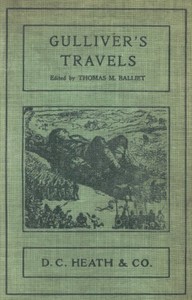
Gulliver's Travels into Several Remote Regions of the World — Text and Context
(0 User reviews)
111
Project Gutenberg
2005
Not confirmed
Fantasy fiction; Satire; Travelers -- Fiction; Gulliver, Lemuel (Fictitious character) -- Fiction; Voyages, Imaginary -- Early works to 1800
Readers of public-domain and historical texts
Project Gutenberg digital edition
en
Edition facts
Words
55,230
Reading time
241 min
Text sections
8
For Gulliver's Travels into Several Remote Regions of the World — Text and Context, the stored edition analysis reports 55,230 words, 4 hr 1 min estimated reading time, and 8 detected text sections.
The text analysis averages about 30.9 words per sentence, while the detected sections provide another way to judge how the source is divided.
Project Gutenberg metadata also associates the work with “Fantasy fiction,” connecting these edition facts with the source record’s subject description.
Source:
Project Gutenberg record #17157
This editorial note examines Jonathan Swift's precise diction, shifting narrative voice, and descriptive scale in Gulliver's Travels, focusing on how word choice and perspective create satirical effect in the Lilliput and Brobdingnag excerpts.
Read the complete public-domain text at its original source.
Read on Project GutenbergJonathan Swift's Gulliver's Travels opens with a narrator who reports his circumstances in a plain, factual tone: "I was in a terrible fright, and kept as far as I could from the edge for fear of falling." This matter-of-fact delivery, even when describing absurd situations, is a deliberate authorial choice that heightens the satire. Swift embeds social commentary not in authorial asides but in the precise, often understated observations of Lemuel Gulliver. The editor Thomas M. Balliet's 1900 edition, which modernizes punctuation and capitalization while preserving the original text, offers a clear window into these stylistic decisions.
Diction and the Satirist's Distance
Swift's word choices consistently maintain a gap between Gulliver's earnest report and the reader's awareness of the absurdity. When Gulliver describes the farmer's wife in Brobdingnag, he notes she "screamed and ran back, as women in England do at the sight of a toad or a spider." The simile is deliberately domestic, grounding the giantess's reaction in familiar English behavior. This technique recurs throughout: Gulliver compares the cat's purring to "a dozen stocking-weavers at work," a simile that is both precise and incongruous. Swift avoids exoticizing the strange; instead, he forces the strange to be measured by the ordinary. The effect is a steady undercutting of Gulliver's reliability—his attempts to normalize the fantastic only underscore its absurdity.
Scale and the Grammar of Perspective
The excerpts reveal how Swift uses numerical precision to control the reader's perception of scale. In Brobdingnag, the dish is "about four-and-twenty feet diameter," the table "thirty feet high from the floor," and the dram cup holds "about three gallons." These measurements are not merely fanciful; they are calculated to maintain internal consistency. Swift's narrator never loses his compulsion to quantify, even when the numbers strain credibility. This habit of exact measurement creates a pseudo-scientific tone that contrasts sharply with the emotional reality of Gulliver's terror—he trembles when the farmer's son holds him aloft. The juxtaposition of cold arithmetic and visceral fear is a structural device that reinforces the satire of Enlightenment rationalism.
Dialogue and Gesture as Narrative Tools
Swift limits direct dialogue in the excerpts, instead relying on reported gestures and sounds to convey interaction. Gulliver "made her a low bow, took out my knife and fork, and fell to eat," and later "took my hat, and, waving it over my head, made three huzzas." These actions substitute for spoken language, emphasizing Gulliver's isolation and his reliance on pantomime. The farmer's family communicates through signs, and Gulliver "observed the signs her husband made" to understand the wife's reconciliation. This emphasis on nonverbal communication underscores the theme of cultural translation—Gulliver must read bodies and objects, not words. Swift's choice to minimize dialogue in these scenes focuses attention on the physical comedy and the power dynamics inherent in size difference.
The Editor's Hand: Balliet's Textual Choices
Thomas M. Balliet's 1900 edition, described as "practically a reprint of the original (1726-27)," makes specific interventions: modernization of punctuation and capitalization, removal of "some archaisms," and omission of "a few passages which would offend modern ears." These changes affect the rhythm and tone of Swift's prose. For instance, the original's longer paragraphs are broken into shorter ones, which may alter the cumulative effect of Swift's satirical buildup. Balliet also adds footnotes for "obsolete words and obscure expressions," guiding the reader's interpretation. Readers of this edition should be aware that the text has been smoothed for a younger audience, potentially softening the edge of Swift's satire. Comparing Balliet's version with the 1726 original reveals how editorial decisions shape the reception of a classic work.
This edition of Gulliver's Travels invites attention to the craft beneath the fantasy. Swift's choices in diction, measurement, and narrative distance are not merely stylistic ornaments but the engines of his satire. Readers who attend to the precise language—the similes drawn from English domestic life, the relentless quantification, the reliance on gesture over speech—will find a work that rewards close reading. Balliet's editorial adjustments, while making the text more accessible, also remind us that every edition is an interpretation.
After Gulliver’s Travels, I kept thinking how the smallest words shape a whole world’s feeling. It reminded me of the quiet way A Double Story — Edition Insights lingered, its gentle precision sitting with me long after the last page. Some books simply stay, like a familiar room you revisit in your mind.
There are no reviews for this eBook.
There are no comments for this eBook.
Reader reflection
Record your reading impressions
A brief reflection can help important ideas stay with you longer.
Your progress
0
/
10
2
How did the book work for you overall?
3
Would you encourage someone else to read it?
4
What was the reading difficulty like?
5
Was the book easy to understand?
6
How valuable was this book for your own interests?
7
How much did the book move you?
8
How personally connected did you feel to the book?
9
What is the main idea you are taking away?
10