1

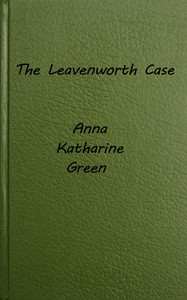
The Leavenworth Case — Story, Setting & Ideas
(0 User reviews)
802
Project Gutenberg
2003
Not confirmed
Detective and mystery stories; Lawyers -- United States -- Fiction; Inheritance and succession -- Fiction; Sisters -- Fiction; Murder -- Investigation -- Fiction; Police -- New York (State) -- New York -- Fiction; Merchants -- Crimes against -- Fiction
Readers of public-domain and historical texts
Project Gutenberg digital edition
en
Edition facts
Words
116,166
Reading time
506 min
Text sections
42
The catalog record for The Leavenworth Case — Story, Setting & Ideas provides practical reading context through 116,166 words, 8 hr 26 min estimated reading time, and 42 detected text sections.
The text analysis averages about 16.8 words per sentence, while the detected sections provide another way to judge how the source is divided.
Project Gutenberg metadata also associates the work with “Detective and mystery stories,” connecting these edition facts with the source record’s subject description.
Source:
Project Gutenberg record #4047
Anna Katharine Green's 1878 detective novel, narrated by lawyer Everett Raymond, follows the murder of wealthy merchant Horatio Leavenworth and the investigation that implicates his two nieces, Eleanore and Mary. The excerpts reveal a focus on legal procedure, psychological tension, and the narrator's personal involvement.
Read the complete public-domain text at its original source.
Read on Project GutenbergAnna Katharine Green's The Leavenworth Case opens with a lawyer-narrator, Everett Raymond, who is immediately drawn into a murder investigation when a agitated young man arrives at his office. The novel's structure—divided into four books with titled chapters—signals a methodical approach to the mystery, yet the excerpts show that Green prioritizes psychological drama over pure puzzle-solving. Raymond's first-person account is marked by self-conscious observations, such as his involuntary rising at the visitor's approach, which establishes his emotional susceptibility. The catalog subjects list lawyers, inheritance, sisters, and police, but the excerpts emphasize the narrator's internal conflict and his evolving relationships with the Leavenworth nieces, particularly Eleanore, whose dialogue reveals a strained family dynamic and a secret involving a man named Clavering.
A Lawyer's Uneasy Perspective
The catalog classifies this work under "Lawyers -- United States -- Fiction," and the excerpts confirm that the legal profession shapes the narrative voice. Raymond frequently notes his professional role—he is a junior partner in a law firm—yet his actions often blur the line between attorney and amateur detective. He assists in preparing the victim's book for publication, a task that gives him access to the household. His narration is filled with qualifiers like "I involuntarily rose" and "I could not prevent a feeling of sickly apprehension," which suggest a man whose emotions override his legal training. The excerpts do not show him conducting formal interviews or examining evidence; instead, he reacts to the women's distress. This tension between professional detachment and personal involvement is a recurring motif, though the excerpts are incomplete regarding how this conflict resolves.
The Sisters and Their Estrangement
Catalog subjects include "Sisters -- Fiction" and "Inheritance and succession -- Fiction," and the excerpts depict a fractured relationship between Eleanore and Mary Leavenworth. In a key scene, Eleanore asks Raymond about Mary's visitors, her voice "expressionless as that of an automaton" when she learns of a man named Clavering. The dialogue reveals that Eleanore has left her cousin's home and feels isolated, while Mary remains in the house with a Mrs. Darrell. The sisters' estrangement is tied to the murder and the uncle's will, but the excerpts do not clarify the cause. Eleanore's horror at the idea of publishing her uncle's book—"How could she? Oh, how could she!"—suggests a deeper conflict over propriety or memory. The catalog's "Inheritance" subject is hinted at but not developed in the provided text.
Clues and Concealment in Dialogue
Green uses dialogue to convey information and conceal motives, a technique visible in the excerpts. When Eleanore asks about Clavering, Raymond hesitates before revealing that the man used two names—Clavering and Robbins—and has left the country. The exchange is laden with subtext: Eleanore's "dress rustled on the hearth; there was a sound of desolation in it" and Raymond's inability to meet her eyes. The catalog lists "Murder -- Investigation -- Fiction," but the excerpts show investigation proceeding through conversation rather than forensic detail. Raymond's observation that Clavering stayed only twenty minutes and left the country is presented as a clue, yet its significance is left ambiguous. The excerpts also include an illustration caption describing Eleanore holding a pistol, which the text may or may not confirm; the provided narrative does not include that moment.
Readers approaching The Leavenworth Case should attend to the narrator's reliability and the way Green embeds clues in social interactions rather than physical evidence. The excerpts suggest a mystery driven by character psychology and legal maneuvering, but the full novel may expand on the police investigation hinted at by the catalog. The sisters' estrangement and the role of Clavering are central threads that the excerpts leave unresolved, inviting careful attention to dialogue and gesture.
Years at this desk, and I still recall the lamp-lit tension in The Leavenworth Case, that lawyer’s trembling loyalty inside a legal maze. It finds a quiet companion in As the Goose Flies — Inside the Classic, which traces a similar patience—how a story waits, unhurried, for its own true reader to arrive. A kinship of hushed persistence.
There are no reviews for this eBook.
There are no comments for this eBook.
Reader reflection
Take a moment to reflect on this book
Create a short personal record of your experience with this book.
Your progress
0
/
10
2
What was your overall reaction to the book?
3
Would you encourage someone else to read it?
4
How much effort did this book require?
5
Which element worked best for you?
6
Would you like to discuss this book with someone?
7
Could you see yourself revisiting this book?
8
How much did the book move you?
9
What did this book teach you most?
10