1

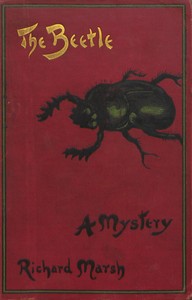
The Beetle: A Mystery — Edition Insights
(0 User reviews)
55
Project Gutenberg
2004
Not confirmed
Horror tales; London (England) -- Fiction; Revenge -- Fiction; Monsters -- Fiction; Politicians -- Fiction; British -- Egypt -- Fiction; Egyptologists -- Fiction; Egypt -- Antiquities -- Collection and preservation -- Fiction; Paranormal fiction; Champnell, Augustus (Fictitious character) -- Fiction
Readers of public-domain and historical texts
Project Gutenberg digital edition
en
Edition facts
Words
118,619
Reading time
516 min
Text sections
11
The Beetle: A Mystery — Edition Insights can be approached with a clearer sense of reading commitment from its source measurements: 118,619 words, 8 hr 36 min estimated reading time, and 11 detected text sections.
The text analysis averages about 15.4 words per sentence, while the detected sections provide another way to judge how the source is divided.
Project Gutenberg metadata also associates the work with “Horror tales,” connecting these edition facts with the source record’s subject description.
Source:
Project Gutenberg record #5164
Richard Marsh's 1897 horror novel uses multiple narrators and shifting paces to build dread around a shape-shifting Egyptian creature pursuing a British politician. The opening chapters alternate between a tramp's desperate, breathless first-person account and a more measured third-person social world, creating a jarring tonal contrast that mirrors the supernatural intrusion into everyday London.
Read the complete public-domain text at its original source.
Read on Project GutenbergThe novel begins not with the titular beetle but with a man banged out of a casual ward. Robert Holt's opening narration is a torrent of physical and psychological exhaustion: 'sick at heart, depressed in mind and in body, exhausted by hunger and fatigue.' The prose here is claustrophobic, driven by short clauses and repeated negatives—'no room,' 'full up,' 'in vain'—that mimic a mind shutting down. This is a voice stripped of ornament, focused on bodily sensation and social humiliation.
Then the narrative shifts. Book II introduces a different register: the measured, reflective voice of Marjorie Lindon, a politician's daughter. Her sentences lengthen, her observations become social and psychological. The contrast is deliberate—the novel's pace changes not just between chapters but between entire narrative modes, from the tramp's raw immediacy to the drawing-room's polished retrospect.
The Tramp's Voice: Hunger and Rhythm
Robert Holt's chapters are the novel's most visceral. His sentences often begin with 'To have' or 'And to have,' building a cumulative, breathless syntax: 'To have tramped about all day looking for work; to have begged even for a job... and to have tramped and to have begged in vain,—that was bad.' The repetition of 'to have' creates a litany of failure, each clause adding weight. The dashes—'that was bad. Much worse. About as bad as bad could be'—act as verbal stumbling, a mind too tired to find new words. Marsh uses this repetitive, intensifying structure to convey a consciousness reduced to its most basic needs: shelter, food, rest. The voice is not literary; it is functional, desperate, and entirely convincing. This is a narrator who does not reflect on his state but lives it, moment by moment, in the prose.
Marjorie's Retrospect: Polished and Political
When Marjorie Lindon takes over the narration, the pace slows and the vocabulary broadens. She describes her growing friendship with Paul Lessingham in long, balanced sentences: 'I do not know how it was. We did not plan our meetings,—at first, at any rate. Yet we seemed always meeting.' The tone is reflective, almost novelistic, with a clear sense of hindsight. She analyses motives—'I believe we did not notice it at the time, but looking back I can see'—and offers social commentary on politicians and women's roles. Her voice is that of an educated woman aware of her father's disapproval, and she uses irony ('papa always puts those sort of words into capitals') to distance herself from his views. The contrast with Holt's raw present-tense suffering is stark: where Holt is trapped in the moment, Marjorie controls her narrative through memory and interpretation.
Pace as a Tool of Unease
Marsh manipulates pace not only between narrators but within them. Holt's chapters are urgent, with short paragraphs and frequent exclamation marks: 'No room!—Full up!' The action is compressed into a few hours. Marjorie's chapters, by contrast, cover weeks or months in a single paragraph, using summary ('After that I read everything of Paul Lessingham's which I came across') to accelerate time. The effect is disorienting: the reader moves from the claustrophobic immediacy of a single night to the leisurely sweep of a courtship. This alternation creates a structural unease, as if the novel itself cannot settle into a consistent tempo. The beetle's intrusion, when it comes, will disrupt both voices—but even before that, the reader senses that the narrative's own rhythms are unstable, shifting without warning between the tramp's panic and the politician's daughter's calm.
Readers attuned to narrative voice will find The Beetle a study in controlled dissonance. The novel does not simply tell a horror story; it makes the reader feel the horror through abrupt changes in register and pace. Pay attention to who is speaking and how long their sentences are—the prose itself becomes a clue to the creature's influence. The tramp's broken rhythms and Marjorie's composed periods are not just stylistic choices; they are the novel's way of mapping the boundary between the ordinary and the monstrous.
Rain came down steady that afternoon, and I kept turning back to the tramp’s frantic opening, that jagged voice against the neat drawing-rooms. It made me think how the most unsettling thing is often the ordinary frame around the strange. Later, idly, I found R. Holmes & Co. Being the Remarkable Adventures of Raffles Holmes, Esq., Detective and Amateur Cracksman by Birth — Text and Context waiting on the shelf—another London, where even the detective’s blood runs crooked, and the rain kept falling outside.
There are no reviews for this eBook.
There are no comments for this eBook.
Reader reflection
Record your reading impressions
A brief reflection can help important ideas stay with you longer.
Your progress
0
/
10
2
Did this book hold your interest?
3
Would you recommend this book to another reader?
4
Did the language feel accessible?
5
Did any part of the book feel personally relevant?
6
What was the strongest part of the book?
7
How useful did the reading feel?
8
Was the book moving at the right speed?
9
Which lesson or insight stayed with you?
10