1

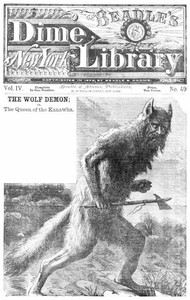
The Wolf Demon; or, The Queen of the Kanawha — Key Ideas to Explore
(0 User reviews)
730
Project Gutenberg
2019
Not confirmed
Revenge -- Fiction; Murder -- Fiction; Dime novels; Indian captivities -- Fiction; Shawnee Indians -- Fiction; Frontier and pioneer life -- Ohio -- Fiction; Hunters -- Fiction; Boone, Daniel, 1734-1820 -- Fiction; Demonology -- Fiction
Readers of public-domain and historical texts
Project Gutenberg digital edition
en
Edition facts
Words
86,367
Reading time
376 min
Text sections
60
The catalog record for The Wolf Demon; or, The Queen of the Kanawha — Key Ideas to Explore provides practical reading context through 86,367 words, 6 hr 16 min estimated reading time, and 60 detected text sections.
The text analysis averages about 13.6 words per sentence, while the detected sections provide another way to judge how the source is divided.
Project Gutenberg metadata also associates the work with “Revenge -- Fiction,” connecting these edition facts with the source record’s subject description.
Source:
Project Gutenberg record #58940
Albert W. Aiken's dime novel uses a prologue set in a moonlit glade, recurring wolf and arrow imagery, and rapid scene shifts between Shawnee villages, forest trails, and frontier cabins to build suspense around the Wolf Demon's identity.
Read the complete public-domain text at its original source.
Read on Project GutenbergThe prologue establishes a pattern of moonlight and shadow that recurs throughout the novel. The opening scene—a glade under a full moon on the Scioto River—introduces the Wolf Demon through the discovery of a slain Shawnee chief marked with a red arrow. This image of the red arrow and the wolf's paw print becomes a signature of the demon's attacks, repeated in later chapters as a visual shorthand for supernatural vengeance.
The narrative moves quickly between locations: from the Shawnee village to the wigwam of the Great Medicine Man, then to forest trails and frontier cabins. These shifts are often abrupt, with chapters ending on a capture or a mysterious appearance and the next beginning in a new setting. The structure favors action over explanation, leaving the reader to piece together the demon's motives from fragmented clues.
Moonlight and Shadow as Recurring Motifs
The prologue's opening sentence—"The great, round moon looked down in a flood of silver light"—sets a visual template that returns in several chapters. Moonlight is used to reveal and conceal: it illuminates the glade but leaves "sable gloom" under the branches. Later, when Virginia is captured, the narrative notes the darkness of the forest and the absence of light. The contrast between silver light and black shadow reinforces the theme of hidden threats.
This motif is not merely atmospheric. The Wolf Demon's attacks occur in darkness or half-light, and the red arrow is often found at dawn or dusk. The Great Medicine Man's wigwam is described as "half hid itself within the borders of the wood," suggesting a liminal space between the known and the supernatural. Readers attentive to these light-dark transitions will notice how they signal impending danger or revelation.
The Red Arrow and the Wolf's Paw
Two symbols dominate the novel: the red arrow and the wolf's paw print. The red arrow appears on the breast of the slain Shawnee chief in the prologue, described as a "fearful token." It is later mentioned as the mark left by the Wolf Demon on his victims. The paw print accompanies the arrow, as when the warriors find "the footprint of an Indian and the mark of a wolf's paw."
These symbols function as a kind of signature, allowing characters to recognize the demon's work without seeing the attacker. They also create a pattern of evidence that the Shawnee chief Ke-ne-ha-ha tries to interpret. The Great Medicine Man claims he can "bring the Wolf Demon before him at once," suggesting that the symbols are not just signs but also tools for summoning or confronting the entity. The repetition of these images builds a sense of ritual and inevitability.
Rapid Scene Shifts and Cliffhanger Endings
The novel's structure relies on quick transitions between settings and characters. The table of contents shows chapters with titles like "The Surprise," "A Mysterious Disappearance," and "A Strange Appearance," each hinting at a twist or revelation. Within the excerpts, the narrative jumps from the glade to the village to the Medicine Man's wigwam without transitional exposition. This technique keeps the pace brisk and mirrors the unpredictability of frontier life.
Chapters often end on a moment of high tension: Virginia wakes to find herself a captive; the Medicine Man offers to produce the Wolf Demon. The next chapter then shifts to a different character or location, leaving the previous scene unresolved. This serialized structure, typical of dime novels, encourages readers to continue through the 42 chapters. The effect is a mosaic of parallel storylines that converge only in the final confrontation.
Dialogue as a Vehicle for Exposition and Suspense
Conversations in the excerpts carry much of the plot's explanatory weight. Ke-ne-ha-ha's dialogue with the Black Cloud and the Great Medicine Man reveals the tribe's fear of the Wolf Demon and their belief in supernatural solutions. The chief's formal speech—"Let the Great Medicine open his ears"—uses repetition and metaphor to convey gravity. Similarly, the Medicine Man's cracked voice and cryptic responses heighten the eerie atmosphere.
Dialogue also advances the mystery. When the Black Cloud suggests consulting the Medicine Man, the chief acts immediately, showing how spoken words drive action. The Medicine Man's offer to "bring the Wolf Demon before him at once" is a direct challenge to the reader's expectations: will the demon appear? This technique of using dialogue to pose questions keeps the narrative focused on the central enigma rather than on descriptive digressions.
Readers should pay attention to how the novel balances its supernatural elements with the historical frontier setting. The Shawnee characters are given distinct voices and motivations, while the white characters like Daniel Boone appear as secondary figures. The Wolf Demon itself remains an ambiguous presence—part spirit, part human—and the clues to its nature are scattered across the rapid scene changes. Approaching the book as a puzzle of symbols and shifts will enhance the reading experience.
This book’s moonlit glade and darting wolf-shadows brought back a childhood dusk, waiting by a window for a father’s return. The Little Washingtons' Travels — Background and Themes once gave me the same ache—not for adventure, but for the quiet spaces between departures and homecomings. That trembling pause, half-hope, half-dark, lingers like a held breath.
There are no reviews for this eBook.
There are no comments for this eBook.
Reader reflection
What was your reading experience?
Capture what you thought, learned, and would like to remember.
Your progress
0
/
10
2
Did this book hold your interest?
3
How likely are you to recommend this book?
4
Did the language feel accessible?
5
How much did the book move you?
6
Was the book moving at the right speed?
7
How well did it match your expectations?
8
Did any part of the book feel personally relevant?
9
What is the main idea you are taking away?
10