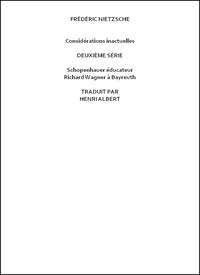
Considérations inactuelles, deuxième série by Friedrich Wilhelm Nietzsche

(20 User reviews)   4481
By Jacob Brown Posted on Dec 22, 2025
In Category - Hard Sci-Fi
Nietzsche, Friedrich Wilhelm, 1844-1900 Nietzsche, Friedrich Wilhelm, 1844-1900
French
Ever feel like you're living in a cultural echo chamber? Nietzsche's 'Untimely Meditations, Second Series' is a philosophical slap in the face. Forget the calm, academic stuff. This is Nietzsche at his most rebellious, tearing down the whole idea of 'useful' history and questioning why we worship the past instead of building the future. He asks if our obsession with history is actually making us sick and weak. It's a short, fierce read that doesn't just make you think—it makes you question the very ground you're standing on. If you're tired of being told how to think, this book is your invitation to start smashing some idols.
Share

Read "Considérations inactuelles, deuxième série by Friedrich Wilhelm Nietzsche" Online

This book is available in the public domain. Start reading the digital edition below.

START READING FULL BOOK
Instant Access    Mobile Friendly

Book Preview

A short preview of the book’s content is shown below to give you an idea of its style and themes.

liste d'autres corrections faites se trouve à la fin du livre. Marquage: _mots en gras_ CONSIDÉRATIONS INACTUELLES DEUXIÈME SÉRIE _OUVRAGES DU MÊME AUTEUR_: PAGES CHOISIES, publiées par HENRI ALBERT, avec une préface. Portrait de Frédéric Nietzsche gravé sur bois par JULIEN TINAYRE 1 vol. L'ORIGINE DE LA TRAGÉDIE, ou _Hellénisme et Pessimisme_, traduit par JEAN MARNOLD et JACQUES MORLAND 1 vol. CONSIDÉRATIONS INACTUELLES (_David Strauss. Les Etudes historiques_), traduit par HENRI ALBERT 1 vol. HUMAIN, TROP HUMAIN (Ire partie), traduit par A.-M. DESROUSSEAUX 2 vol. LE VOYAGEUR ET SON OMBRE, _Opinions et Sentences mêlées_ (_Humain, trop humain_, IIe partie), traduit par HENRI ALBERT 1 vol. AURORE (_Réflexions sur les Préjugés moraux_); traduit par HENRI ALBERT 1 vol. LE GAI SAVOIR (_La Gaya Scienza_), traduit par HENRI ALBERT 1 vol. AINSI PARLAIT ZARATHOUSTRA, traduit par HENRI ALBERT 1 vol. PAR DELA LE BIEN ET LE MAL, _Prélude d'une philosophie de l'Avenir_, traduit par HENRI ALBERT 1 vol. LA GÉNÉALOGIE DE LA MORALE, traduit par HENRI ALBERT 1 vol. LE CRÉPUSCULE DES IDOLES, LE CAS WAGNER, NIETZSCHE CONTRE WAGNER, L'ANTÉCHRIST, traduits par HENRI ALBERT 1 vol. LA VOLONTÉ DE PUISSANCE, _Essai d'une transmutation de toutes les valeurs_, traduit par HENRI ALBERT 2 vol. ECCE HOMO, suivi des POÉSIES, traduit par HENRI ALBERT 1 vol. ŒUVRES COMPLÈTES DE FRÉDÉRIC NIETZSCHE PUBLIÉES SOUS LA DIRECTION DE HENRI ALBERT FRÉDÉRIC NIETZSCHE Considérations inactuelles DEUXIÈME SÉRIE Schopenhauer éducateur Richard Wagner à Bayreuth TRADUIT PAR HENRI ALBERT [Illustration] PARIS MERCVRE DE FRANCE XXVI, RVE DE CONDÉ, XXVI MCMXXII IL A ÉTÉ TIRÉ: _12 exemplaires sur Hollande van Gelder numérotés à la presse de 1 à 12._ JUSTIFICATION DU TIRAGE: 660 Tous droits de reproduction et d'adaptation réservés pour tous pays. I SCHOPENHAUER ÉDUCATEUR (1874) 1. Ce voyageur, qui avait vu beaucoup de pays et de peuples, et visité plusieurs parties du monde, et à qui l'on demandait quel était le caractère général qu'il avait retrouvé chez tous les hommes, répondait que c'était leur penchant à la paresse. Certaines gens penseront qu'il eût pu répondre avec plus de justesse: ils sont tous craintifs. Au fond, tout homme sait fort bien qu'il n'est sur la terre qu'une seule fois, en un exemplaire unique, et qu'aucun hasard, si singulier qu'il soit, ne réunira, pour la seconde fois, en une seule unité, quelque chose d'aussi multiple et d'aussi curieusement mêlé que lui. Il le sait, mais il s'en cache, comme s'il avait mauvaise conscience. Pourquoi? Par crainte du voisin, qui exige la convention et s'en enveloppe lui-même. Mais qu'est-ce qui force l'individu à craindre le voisin, à penser, à agir selon le mode du troupeau, et à ne pas être content de lui-même? La pudeur peut-être chez certains, mais ils sont rares. Chez le plus grand nombre, c'est le goût des aises, la nonchalance, bref ce penchant à la paresse dont parle le voyageur. Il a raison: les hommes sont encore plus paresseux que craintifs, et ce qu'ils craignent le plus ce sont les embarras que leur occasionneraient la sincérité et la loyauté absolues. Les artistes seuls détestent cette attitude relâchée, faite de convention et d'opinions empruntées, et ils dévoilent le mystère, ils montrent la mauvaise conscience de chacun, affirmant que tout homme est un mystère unique. Ils osent nous montrer l'homme tel qu'il est lui-même et lui seul, jusque dans tous ses mouvements musculaires; et mieux encore, que, dans la stricte conséquence de son individualité, il est beau et digne d'être contemplé, qu'il est nouveau et incroyable comme toute œuvre de la nature, et nullement ennuyeux. Quand le grand penseur méprise les hommes, il méprise leur paresse, car c'est à...

This is a limited preview. Download the book to read the full content.

The Story

This isn't a story with characters and a plot. It's a series of four powerful essays where Nietzsche takes aim at the Germany of his time. He sees a society drowning in historical knowledge but lacking any real life or creative power. The first essay, 'On the Uses and Disadvantages of History for Life,' is the famous one. He argues that treating history like a sacred museum piece is toxic. It weighs us down, makes us feel small, and stops us from creating anything new. The other three essays look at specific figures, but they all circle back to the same core idea: we need to break free from the past to become who we are meant to be.

Why You Should Read It

I picked this up expecting dry philosophy and got a shot of adrenaline instead. Nietzsche's anger is contagious. He writes with the urgency of someone trying to wake up a sleeping world. His point about 'historical sickness' hit me hard. How much of what we learn, watch, and consume is just us rehashing the past instead of making something original? It’s a challenging, sometimes uncomfortable read because he forces you to look at your own life and ask if you're living it, or just curating it.

Final Verdict

Perfect for anyone feeling restless with modern culture, for creative people stuck in a rut, or for readers who want to meet Nietzsche at his most direct and combative. It's not an easy introduction to his work, but it's a pure, undiluted taste of his revolutionary spirit. If you're ready to have your assumptions about progress, education, and culture thoroughly shaken, this is your book.


ℹ️ Public Domain Notice

This publication is available for unrestricted use. Use this text in your own projects freely.

Karen Gonzalez
11 months ago

Based on the summary, I decided to read it and the arguments are well-supported by credible references. I learned so much from this.

Andrew Anderson
1 year ago

A must-have for anyone studying this subject.

George Martinez
1 year ago

I started reading out of curiosity and the author's voice is distinct and makes complex topics easy to digest. I will read more from this author.

Margaret Brown
1 year ago

A must-have for anyone studying this subject.

Elijah Davis
6 months ago

After hearing about this author multiple times, it creates a vivid world that you simply do not want to leave. I couldn't put it down.
4.5
4.5 out of 5 (20 User reviews )

Add a Review

Your Rating *
There are no comments for this eBook.
You must log in to post a comment.
Log in


Related eBooks