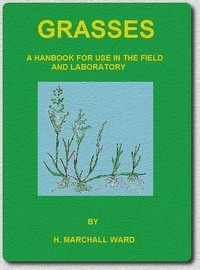
Grasses : A handbook for use in the field and laboratory by H. Marshall Ward

(7 User reviews)   4159
By Jacob Brown Posted on Dec 22, 2025
In Category - Alien Worlds
Ward, H. Marshall (Harry Marshall), 1854-1906 Ward, H. Marshall (Harry Marshall), 1854-1906
English
Okay, hear me out. I know a 1904 book about grass sounds like the definition of a dusty snooze-fest. But this isn't just a field guide. It's a time capsule from the dawn of modern botany, written by a scientist fighting to make people see the world differently. The 'mystery' here isn't a whodunit—it's the hidden, complex life of the plants we walk over every day. Ward wants you to stop, get on your hands and knees, and realize that a single blade of grass is a universe of engineering and adaptation. It's surprisingly radical for its time, and it completely changed how I look at my own backyard.
Share

Read "Grasses : A handbook for use in the field and laboratory by H. Marshall Ward" Online

This book is available in the public domain. Start reading the digital edition below.

START READING FULL BOOK
Instant Access    Mobile Friendly

Book Preview

A short preview of the book’s content is shown below to give you an idea of its style and themes.

forward on pp. 72-82, and prepared the drawings for Figs. 21-28. That errors are entirely absent from such a work as this is perhaps too much to expect: I hope they are few, and that readers will oblige me with any corrections they may find necessary or advantageous for the better working of the tables. The list of the chief authorities referred to, which students who desire to proceed further with the study of grasses should consult, is given at the end. I have pleasure in acknowledging my indebtedness to the following works for illustrations which are inserted by permission of the several publishers:--Stebler’s _Forage Plants_ (published by Nutt & Co.), Nobbe’s _Handbuch der Samenkunde_ (Wiegandt, Hempel and Parey, Berlin), Harz’s _Landwirthschaftliche Samenkunde_ (Paul Parey, Berlin), Strasburger and Noll’s _Text-Book of Botany_ (Macmillan & Co.), Figuier’s _Vegetable World_ (Cassell & Co.), Lubbock’s _Flowers, Fruits and Seeds_ (Macmillan & Co.), Kerner’s _Natural History of Plants_ (Blackie & Son), and Oliver’s _First Book of Indian Botany_ (Macmillan & Co.). It is impossible to avoid the question of variation in work of this kind, and students will without doubt come across instances--especially in such genera as _Agropyrum_, _Festuca_, _Agrostis_ and _Bromus_--of small variations which show how impossible it is to fit the facts of living organisms into the rigid frames of classification. It may possibly be urged that this invalidates all attempts at such classifications: the same argument applies to all our systems, though it is perhaps less disastrous to the best Natural Systems which attempt to take in large groups of facts, than to artificial systems selected for special purposes. Perhaps something useful may be learned by showing more clearly where and how grasses vary, and I hope that the application to them of these preliminary tests may elucidate more facts as we proceed. H. M. W. CAMBRIDGE, _April_, 1901. CONTENTS. CHAPTER I. PAGE THE VEGETATIVE ORGANS 1 CHAPTER II. THE VEGETATIVE ORGANS (_continued_) 17 CHAPTER III. GRASSES CLASSIFIED ACCORDING TO THEIR VEGETATIVE CHARACTERS 39 CHAPTER IV. ANATOMY AND HISTOLOGY 62 CHAPTER V. GRASSES CLASSIFIED ACCORDING TO THE ANATOMICAL CHARACTERS OF THE LEAF 72 CHAPTER VI. GRASSES IN FLOWER 83 CHAPTER VII. GRASSES GROUPED ACCORDING TO THEIR FLOWERS AND INFLORESCENCES 99 CHAPTER VIII. THE FRUIT AND SEED 119 CHAPTER IX. CLASSIFICATION OF GRASSES BY THE “SEEDS” (GRAINS) 135 BIBLIOGRAPHY 175 INDEX, GLOSSARY AND LIST OF SYNONYMS 177 CHAPTER I. THE VEGETATIVE ORGANS. That grasses are interesting and important plants is a fact recognised by botanists all the world over, yet it would appear that people in general can hardly have appreciated either their interest or their importance seeing how few popular works have been published concerning their structure and properties. Apart from their almost universal distribution, and quite apart from the fascinating interest attaching to those extraordinary tropical giants, the Bamboos, West Indian Sugar-cane, the huge Reed-grasses of Africa, the Pampas-grasses of South America; and from the utilitarian value of the cereals--Maize, Rice, Wheat and other corn, &c.--everyone must be struck by the significance of the enormous tracts of land covered by grasses in all parts of the world, the Prairies of North America and the Savannahs of the South, the Steppes of Russia and Siberia, and the extensive tracts of meadow and pasture-land in Europe being but a few examples. Although in the actual number of species the Grass family is by no means the largest in the vegetable kingdom, for there are far more Composites or Orchids, the curious sign of success in the struggle for existence comes out in grasses in that the number of _individuals_ far transcends those...

This is a limited preview. Download the book to read the full content.

Forget sprawling plots or dramatic characters. Grasses: A Handbook has a different mission. It’s a direct, practical guide written to get you—the curious amateur or student—out into a meadow with a hand lens and a notebook. Ward systematically walks you through how to identify grasses, from their roots and stems to their intricate flowers. He explains how to collect specimens, press them, and examine them under a microscope. The ‘story’ is the process of discovery itself, moving from casual observation to deep, scientific understanding.

Why You Should Read It

Reading this is like getting a private lesson from a brilliant, patient teacher. Ward’s passion is contagious. He isn’t just listing facts; he’s showing you a method for seeing. You can feel his urgency to share this knowledge, to build a generation of people who appreciate botany. It’s a snapshot of science when it was still deeply connected to hands-on fieldwork. While some terms are old-fashioned, the core message—that careful observation unlocks the secrets of the natural world—is timeless and deeply satisfying.

Final Verdict

This isn't for everyone. If you want a breezy nature read, look elsewhere. But if you’re a gardener, a history of science nerd, a writer seeking period detail, or just someone who’s ever looked at a field and wondered ‘What exactly am I looking at?’, this book is a treasure. It’s perfect for anyone who believes that true wonder lies in understanding the details. Just be prepared to see your lawn in a whole new, slightly obsessive light.


🟢 Legacy Content

The copyright for this book has expired, making it public property. You do not need permission to reproduce this work.

Mason Rodriguez
1 year ago

High quality edition, very readable.

Linda Martin
1 year ago

Compatible with my e-reader, thanks.

Aiden Garcia
10 months ago

To be perfectly clear, the pacing is just right, keeping you engaged. I will read more from this author.

Barbara Rodriguez
1 year ago

After hearing about this author multiple times, the author's voice is distinct and makes complex topics easy to digest. Exceeded all my expectations.

Brian Taylor
1 year ago

I didn't expect much, but the character development leaves a lasting impact. Absolutely essential reading.


4.5
4.5 out of 5 (7 User reviews )

Add a Review

Your Rating *
There are no comments for this eBook.
You must log in to post a comment.
Log in


Related eBooks