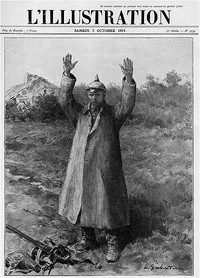
L'Illustration, No. 3735, 3 Octobre 1914 by Various

(16 User reviews)   5586
By Jacob Brown Posted on Jan 13, 2026
In Category - Hard Sci-Fi
Various Various
French
Hey, I just read something that completely changed how I see World War I. It’s not a novel or a history book—it’s a single weekly issue of a French magazine from October 1914, called 'L'Illustration.' Think of it as a time capsule. The war is just two months old, and the full horror of the trenches hasn't sunk in yet. You get this wild mix of raw frontline reports, patriotic art, and... ads for perfume and cars right next to casualty lists. The main conflict isn't in a plot; it's in the pages themselves. It's the battle between the hopeful, almost naive, spirit on display and the brutal reality we know was coming. It’s like watching a society trying to convince itself everything will be fine, while the foundations are already crumbling. It’s haunting, fascinating, and gives you chills in a way a textbook never could. You have to check it out.
Share

Read "L'Illustration, No. 3735, 3 Octobre 1914 by Various" Online

This book is available in the public domain. Start reading the digital edition below.

START READING FULL BOOK
Instant Access    Mobile Friendly

Book Preview

A short preview of the book’s content is shown below to give you an idea of its style and themes.

derselben, oder erstlich alles das, was in dem Zürcher Abdrucke von S. 1 des ersten Theiles bis S. 172 befindlich ist, nur dass auf /Kúnig Chůnrat/, /Kúnig Tyro von Schotten und Fridebrant sin sun/ folgt, oder das Gedicht, das in dem zweyten Theile der Samml. von Minnes. von S. 248 bis S. 251 abgedruckt ist. Mit dem Worte _kumberliche_ in der letzten Zeile der fünften Strophe der Lieder des /Her Bernge von Horhein/ bricht die Handschrift ab. Ausser dem aber sind zweytens noch von den in dem zweyten Theile der Zürcher Ausgabe befindlichen Gedichten abgeschrieben /Der Tanhuser/, /Von Bůchein/ und die ersten Lieder des /Her Nithart/ (Samml. von Minnes. Th. 2. S. 58 bis S. 72). Die letzte Zeile, womit die Handschrift endigt, ist: ‚Nu seht ob ich ze frouwen wol an ir behalten si.' -- Das beygefügte Verzeichniss der Dichter ist mit dem in dem zweyten Theile des Zürcher Abdruckes S. 261 und 262 befindlichen vollkommen gleichlautend. Man kann, wenn ich nicht irre, in dieser Bremischen Handschrift fünferley Hände unterscheiden. Die erste geht bis zu den Liedern des Grafen /Chůnrat von Kilchberg/; die zweyte von da bis auf /Her Walter von Klingen/; die dritte bis zu der Zeile ‚Swer ane vorhte herre Got' (Samml. von Minnes. Th. 1. S. 128. Col. 2.); die vierte bis zu dem schon angeführten Worte ‚kumberliche' in den Liedern des /Her Bernge von Horhein/ (Samml. von Minnes. Th. 1. S. 172 f.). Von der fünften Hand endlich ist abgeschrieben was im zweyten Theile der Samml. von Minnes. von S. 58 bis S. 72 steht. Die drey ersten Hände zeugen von Schreibern, die der alten Sprache kundig waren; die vierte Hand ist weit schlechter, und man sieht deutlich, dass der Abschreiber nicht verstand was er schrieb. Unter andern steht gewöhnlich _nn_ statt _m_ und _m_ statt _n_, woraus zu schliessen ist, dass diese Buchstaben sich in der Original-Handschrift sehr ähnlich sehen müssen, um so mehr, da auch schon früher sich öfter _n_ findet, wo der Zürcher Abdruck _m_ hat, und umgekehrt. Diese vier ersten Hände bedienten sich durchaus der Lateinischen Buchstaben; von der fünften Hand sind die so genannten Deutschen Buchstaben gebraucht, und der Abschreiber war, wie es scheint, der alten Sprache etwas kundiger. Die einzelnen Lieder jedes Dichters sind mit Römischen Zahlen bezeichnet, die Strophen mit Arabischen. Die Reimzeilen sind abgesetzt, wiewohl nicht immer ganz richtig. Interpunction ist nur an äusserst wenigen Stellen beygefügt. Die Bremische Handschrift enthält, so weit sie geht, _alles_ was in der Samml. von Minnes. abgedruckt ist (denn eine kleine unten S. 276 bemerkte Ausnahme kann eigentlich gar nicht als Ausnahme gelten); und sie enthält ein gutes Theil _mehr_. Meine Überzeugung, dass der Zürcher Abdruck lückenhaft sey, wurde durch diese Handschrift vollkommen bestätigt. Wie es aber möglich war, dass die Herausgeber vollständige Lieder in unverständliche Bruchstücke verwandelten, und wie es kam, dass sie manches schöne Lied ganz übergingen, das begreife ich nicht, und schwerlich ist jemand jetzt noch im Stande, eine befriedigende Auskunft darüber zu geben. Auf alle Fälle wünschte ich, bey der grossen Achtung, die ich für /Bodmer/ hege, dass er in seiner Vorrede zu dem zweyten Theil der Samml. von Minnes. die Stelle (S. V), in der er einiger wenigen ausgelassenen Strophen erwähnt, durchgestrichen oder weniger hochfärtig ausgedrückt hätte. Die folgenden Bogen enthalten die Ausbeute, welche die Vergleichung der Bremischen Handschrift lieferte. Abschrift und Abdruck sind mit pflichtmässiger Genauigkeit besorgt worden; da wo es mir nöthig schien, nach Vermuthung gemachte Verbesserungen in den Text aufzunehmen, habe ich, wenige unbedeutende Veränderungen ausgenommen, die Lesart der Handschrift unter dem Texte angegeben. Die beygefügte Interpunction wird, wie ich hoffe, den meisten...

This is a limited preview. Download the book to read the full content.

This isn't a book with a traditional story. L'Illustration was one of France's most popular weekly news magazines, and this issue captures a precise moment in time: the early autumn of 1914. World War I was eight weeks old. The Battle of the Marne had just halted the German advance, and a fragile hope, known as the 'Miracle of the Marne,' was in the air.

The Story

The 'story' unfolds across its densely illustrated pages. It opens with a grand, heroic portrait of General Joffre, the architect of the Marne victory. You'll find detailed maps showing troop movements (which now feel strangely optimistic), photographs of soldiers at the front looking determined, and lavish drawings of French cavalry charges. But then you turn the page. There are lists of the dead and wounded. Advertisements for the latest fashions and luxury goods sit uneasily beside appeals for donations to support war orphans. There are technical articles about new weapons alongside sentimental poetry. The narrative it tells is one of a nation mobilizing, celebrating its first major success, and trying desperately to maintain a sense of normalcy while its young men were already dying in shocking numbers.

Why You Should Read It

Reading this is an incredibly powerful experience. A history book tells you what happened. This shows you how it felt to be living through it, before anyone knew how long or terrible it would become. The disconnect is breathtaking. The heroic art and confident headlines project strength, but a closer look reveals the cracks. It makes the war feel immediate and human, not just a series of dates and battles. You're not just learning about history; you're witnessing the psychology of a society at war, caught between patriotism, propaganda, commerce, and creeping dread. It's more revealing than any official document.

Final Verdict

Perfect for history buffs who want to move beyond facts and figures, and for anyone fascinated by media, propaganda, and human psychology. If you enjoy primary sources that let you draw your own conclusions, this is a treasure. It's not a light read, but it's a short, immersive one that will stick with you. You won't find a clearer window into the anxious, hopeful, and tragic heart of October 1914.


📚 Usage Rights

The copyright for this book has expired, making it public property. Distribute this work to help spread literacy.

Betty Thomas
1 year ago

Thanks for the recommendation.

Emily Smith
1 year ago

Compatible with my e-reader, thanks.

Sarah Garcia
1 year ago

I have to admit, the clarity of the writing makes this accessible. A true masterpiece.

Steven Hernandez
10 months ago

After hearing about this author multiple times, it manages to explain difficult concepts in plain English. Truly inspiring.

Ashley King
6 months ago

Simply put, the narrative structure is incredibly compelling. Absolutely essential reading.
4.5
4.5 out of 5 (16 User reviews )

Add a Review

Your Rating *
There are no comments for this eBook.
You must log in to post a comment.
Log in


Related eBooks