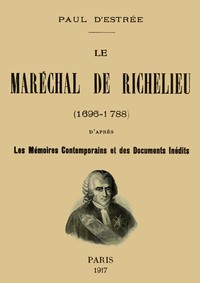
Le Maréchal de Richelieu (1696-1788) by Paul d' Estrée

(9 User reviews)   5045
By Jacob Brown Posted on Jan 3, 2026
In Category - Alien Worlds
Estrée, Paul d', 1838-1922 Estrée, Paul d', 1838-1922
French
You think you know Louis XIV's France? Think again. This biography isn't about the famous Cardinal Richelieu, but his scandalous great-nephew, the Marshal. Forget the powdered wigs and polite manners—this is the story of a man who lived through three kings, fought in wars, and became France's most notorious playboy at the age of 84. Paul d'Estrée pulls back the velvet curtain on the 18th century's most outrageous survivor. It's less a dry history and more a wild ride through bedrooms, battlefields, and royal court intrigue with a character who makes modern celebrities look tame.
Share

Read "Le Maréchal de Richelieu (1696-1788) by Paul d' Estrée" Online

This book is available in the public domain. Start reading the digital edition below.

START READING FULL BOOK
Instant Access    Mobile Friendly

Book Preview

A short preview of the book’s content is shown below to give you an idea of its style and themes.

La ponctuation a été tacitement corrigée à plusieurs endroits. Le texte marqué =ainsi= est en imprimé en gras dans l'original. Vous pourrez rencontrer des abréviations telles que M{al} (Maréchal), C{l} (Colonel), M{is} (Marquis) etc. Les signes entre accolades sont en exposant dans l'original. Les notes de bas de page ont été renumérotées consécutivement et déplacées pour apparaître après le ou les paragraphes correspondants. Dans l'Index les notes sont indiquées par le numéro de la page précédé d'un astérisque. Pour faciliter les recherches, nous y avons ajouté le numéro de la note entre crochets comme ceci: *159[243]. Certaines de ces références manquent, lorsque nous n'avons pas trouvé la note correspondante. LE MARÉCHAL DE RICHELIEU OUVRAGES DE PAUL D’ESTRÉE =Œuvres inédites de Motin= (avec notice et notes). Paris, librairie des bibliophiles, 1883. =Mémoires de Voltaire, écrits par lui-même= (avec notes et commentaires). Paris, Kolb, 1891. =Les Hohenzollern= (en collaboration avec E. Neukomm). Paris, Perrin et Cie, 1892. =Un policier homme de lettres. L’Inspecteur Meusnier= (1748-1757). Paris, aux bureaux de la Nouvelle Revue rétrospective, 1892. =Les Explosifs au XVIIIe siècle.= Paris, aux bureaux de la Nouvelle Revue rétrospective, 1894. =Journal inédit du lieutenant de police Feydeau de Marville= (1744). Paris, aux bureaux de la Nouvelle Revue rétrospective, 1897. =Les théâtres libertins du XVIIIe siècle= (en collaboration avec Henri d’Alméras). Paris, Daragon, 1905. _Épuisé._ =Les Organes de l’Opinion publique dans l’Ancienne France= (en collaboration avec Fr. Funck-Brentano). Paris, Hachette et Cie. I. =Les Nouvellistes=, 2e édition, 1905. II. =Figaro et ses devanciers=, 1909. III. =La Presse clandestine= (en préparation). =Le Père Duchesne. Hébert et la Commune de Paris= (1792-1794) (Couronné par l’Académie française.) Paris, Ambert et Cie, 1909. =La Duchesse d’Aiguillon= (en collaboration avec A. Callet). Paris, Émile-Paul, 1912. =Un Rebouteur du Val d’Ajol et la Légende de Valdajou.= (Bulletin de la Société française de l’Histoire de la Médecine.) 1912. =Le théâtre sous la Terreur= (=Théâtre de la Peur, 1792-1794=). Paris, Émile-Paul, 1913. _EN PRÉPARATION:_ =La Vieillesse de Richelieu (1758-1788).= [Illustration: Le Maréchal Duc de RICHELIEU (_d’après une gravure du temps_)] PAUL D’ESTRÉE LE MARÉCHAL DE RICHELIEU (1696-1788) D’APRÈS =Les Mémoires Contemporains et des Documents Inédits= CINQUIÈME ÉDITION PARIS ÉMILE-PAUL FRÈRES, ÉDITEURS 100, RUE DU FAUBOURG SAINT-HONORÉ, 100 _Ce livre, commencé en 1912 et terminé en 1914, avait été remis à l’imprimeur quelques jours avant la Guerre. Il dut attendre, pour paraître, une heure plus propice._ _Par une coïncidence alors impossible à prévoir, il signalait, chez un peuple né à la vie internationale, dès le début du XVIIIe siècle[1], l’essor et les manifestations d’une politique, ne laissant que trop pressentir, même à cent-soixante ans de distance, l’agression inique et féroce qui devait mettre, de nos jours, la France à deux doigts de sa perte._ [1] Dans les siècles précédents, comme le démontrent les historiens allemands et les Archives de Berlin, les Marquis de Brandebourg, et notamment le Grand Électeur, s’étaient efforcés d’affirmer l’existence de la Prusse, soit par des démonstrations militaires, soit par des négociations diplomatiques ou commerciales. Mais ce ne fut qu’à la fin du XVIIe siècle et au commencement du XVIIIe que la Prusse entra réellement dans le concert européen. _Or, au_ XVIIIe _siècle, conformément à des traditions qu’une diplomatie avisée voudrait faire aujourd’hui revivre en les adaptant aux nécessités présentes, la monarchie bourbonienne s’étudiait à maintenir, par un système d’alliances utile à ses intérêts et à sa sécurité, les conditions d’existence qui réglaient les rapports des principautés allemandes entre elles. Et lorsque, à partir de 1740, l’avidité inquiétante de la Prusse, exploitée par son Souverain, tendit à rompre, à son profit, ce salutaire équilibre, un homme--celui qui fait l’objet de cette...

This is a limited preview. Download the book to read the full content.

Ever heard the saying "truth is stranger than fiction"? This book proves it. Le Maréchal de Richelieu follows the absurdly long and scandal-packed life of Louis François Armand de Vignerot du Plessis. He was a soldier, a diplomat, and the ultimate court insider, but his real legacy was as a legendary libertine whose romantic conquests were the talk of Europe.

The Story

This isn't a simple timeline of battles and treaties. D'Estrée structures the book around the Marshal's greatest exploits and escapes. We see him as a young man imprisoned in the Bastille for defying the king's wishes, then climbing his way back to power. We follow him through wars and peace treaties. But the real drama is in the salons and private chambers, where his love affairs caused constant uproar. The central thread is how a man known for his wit, charm, and utter lack of discretion managed to not just survive but thrive in a cutthroat world for over nine decades.

Why You Should Read It

I picked this up expecting a stuffy military history. What I got was a hilarious and sometimes shocking window into the real Ancien Régime. The Marshal is a fascinating contradiction: brave in battle yet endlessly vain, politically shrewd but emotionally reckless. D'Estrée writes with a wink, letting the sheer audacity of his subject's life speak for itself. You're not just learning history; you're following the ultimate gossip column from 300 years ago.

Final Verdict

Perfect for anyone who finds traditional history books a bit dry. If you enjoy character-driven stories, real-life drama, and a peek behind the stiff formality of royal courts, this is your next read. It's for readers who like their biographies filled with personality, mischief, and a reminder that human nature—especially the love of gossip and scandal—hasn't changed one bit.


⚖️ Public Domain Notice

This is a copyright-free edition. It is available for public use and education.

Patricia King
8 months ago

Read this on my tablet, looks great.

Edward Rodriguez
1 year ago

I started reading out of curiosity and the clarity of the writing makes this accessible. One of the best books I've read this year.

Donald Clark
1 year ago

Great digital experience compared to other versions.

Brian Clark
5 months ago

This book was worth my time since the emotional weight of the story is balanced perfectly. Worth every second.

Sarah Wright
1 year ago

I started reading out of curiosity and the plot twists are genuinely surprising. Exceeded all my expectations.

4.5
4.5 out of 5 (9 User reviews )

Add a Review

Your Rating *
There are no comments for this eBook.
You must log in to post a comment.
Log in


Related eBooks