1

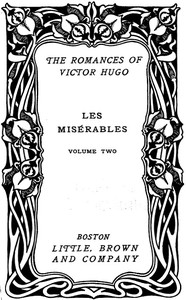
Les Misérables, v. 2/5: Cosette — Story, Setting & Ideas
(0 User reviews)
988
Project Gutenberg
2015
Not confirmed
Historical fiction; Orphans -- Fiction; Paris (France) -- Fiction; Epic literature; Ex-convicts -- Fiction
Readers of public-domain and historical texts
Project Gutenberg digital edition
en
Edition facts
Words
99,825
Reading time
435 min
Text sections
9
For Les Misérables, v. 2/5: Cosette — Story, Setting & Ideas, the stored edition analysis reports 99,825 words, 7 hr 15 min estimated reading time, and 9 detected text sections.
The text analysis averages about 20.0 words per sentence, while the detected sections provide another way to judge how the source is divided.
Project Gutenberg metadata also associates the work with “Historical fiction,” connecting these edition facts with the source record’s subject description.
Source:
Project Gutenberg record #48732
This volume follows Jean Valjean and Cosette from Waterloo's aftermath to a Paris convent. Hugo juxtaposes battle's chaos with a child's quiet rescue, using structural contrasts and recurring images of darkness, hands, and thresholds.
Read the complete public-domain text at its original source.
Read on Project GutenbergThe second volume of Les Misérables opens not with its title character but with the Battle of Waterloo, a prolonged set piece that occupies the entire first book. Hugo devotes nineteen chapters to the field, the tactics, and the aftermath before returning to Jean Valjean and the orphaned Cosette. This structural choice establishes a pattern: the novel moves between vast historical forces and intimate domestic scenes, between the noise of armies and the silence of a child alone in a forest. The Waterloo section is not merely background; it introduces motifs—darkness, mud, a hand reaching out—that will recur when Valjean lifts Cosette from the Thénardiers' inn.
Waterloo as Prologue and Metaphor
The Waterloo chapters are dense with tactical detail: the sunken road of Ohain, the arrival of Bülow's corps, the last square of the Imperial Guard. Yet Hugo repeatedly interrupts the military narrative with philosophical digressions—on the nature of chance, the meaning of defeat, the role of the guide who misleads Napoleon. These interruptions mirror the novel's own method: a story that keeps stepping back to ask what it means. The battle's aftermath introduces a grave-digger and a theft, linking Waterloo directly to the plot. A sergeant strips a dead officer's boots; a corporal takes a purse. These small acts of predation echo the larger predation of war and foreshadow the predatory Thénardiers who will exploit Cosette.
The Child in the Dark
Cosette's first extended scene places her alone in a forest at night, sent to fetch water from a spring. Hugo emphasizes her smallness against the vast, indifferent landscape: “the little one alone” is the chapter's title. The darkness is not merely atmospheric but structural—it forces the reader to perceive the world from a child's limited perspective. Cosette hears rustling, sees shadows, and feels the weight of the bucket. When a large hand suddenly takes the bucket from her, the gesture is both rescue and intrusion. Hugo writes that “the mysterious impression produced upon Cosette … by Jean Valjean's hand grasping hers in the darkness was not an illusion but a reality.” The hand becomes a recurring image of connection across the volume.
The Convent as Sanctuary and Prison
After escaping Javert, Jean Valjean and Cosette take refuge in the Petit-Picpus convent. Hugo devotes an entire book to the convent's rules, history, and daily routines: the nuns' severe silence, their “severities” and “gayeties,” the distinction between choir sisters and lay sisters. The convent is a world of thresholds—doors that lock, grilles that separate, habits that erase identity. Valjean enters by hiding in a coffin, a literal passage through death. The structure of this section mirrors the earlier Waterloo book: long, digressive, almost documentary. Yet the convent also provides the quiet stability that allows Cosette to learn to read and to form her first attachment. The walls that imprison also protect.
Recurring Images: Hands, Darkness, and Thresholds
Three images recur across the volume. Hands: Valjean's hand taking the bucket, his hand kissing Cosette's chilblained fingers, the hand of the dying soldier at Waterloo. Hands connect, rescue, or fail to grasp. Darkness: the night of Waterloo, the forest where Cosette fetches water, the convent's dim corridors. Darkness is both threat and cover—it hides Valjean from Javert and allows the coffin escape. Thresholds: the inn door Cosette is afraid to enter, the convent gate that closes behind her, the boundary between the battlefield and the road. Hugo's narrative itself moves across thresholds, from epic battle to domestic interior, from historical essay to intimate portrait. These structural shifts are not digressions but the novel's way of asking how individual lives intersect with large forces.
Readers approaching this volume should attend to the way Hugo builds meaning through juxtaposition. The Waterloo chapters are not a detour but a key: they establish a world where violence is random, where the powerful fall and the cunning survive. Against this backdrop, the rescue of a single child becomes an act of defiance. The convent chapters, for all their detail, are not static—they are a pause before the next movement. Watch for the small gestures—a hand offered, a door opened—that carry the weight of the novel's argument about redemption.
I’ve often thought Hugo’s dark convent walls, where Valjean’s hidden hand slips Cosette through a threshold into safety, share a quiet kinship with a pauper’s sudden borrowed crown. Both stories whisper about identities stitched from circumstance, not souls. There is a gentle ache in that. The Prince and the Pauper, Part 6. — Background and Themes remembers it too, I believe.
There are no reviews for this eBook.
There are no comments for this eBook.
Reader reflection
What was your reading experience?
Capture what you thought, learned, and would like to remember.
Your progress
0
/
10
2
Was reading this book enjoyable?
3
How likely are you to recommend this book?
4
How demanding did the text feel?
5
Do you expect to return to this book?
6
How well did it match your expectations?
7
How would you describe its reading pace?
8
Which part made the strongest impression?
9
What did this book teach you most?
10