1

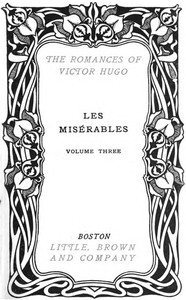
Les Misérables, v. 3/5: Marius — Reading Companion
(0 User reviews)
74
Project Gutenberg
2015
Not confirmed
Historical fiction; Orphans -- Fiction; Paris (France) -- Fiction; Epic literature; Ex-convicts -- Fiction
Readers of public-domain and historical texts
Project Gutenberg digital edition
en
Edition facts
Words
91,117
Reading time
397 min
Text sections
8
Les Misérables, v. 3/5: Marius — Reading Companion can be approached with a clearer sense of reading commitment from its source measurements: 91,117 words, 6 hr 37 min estimated reading time, and 8 detected text sections.
The text analysis averages about 19.2 words per sentence, while the detected sections provide another way to judge how the source is divided.
Project Gutenberg metadata also associates the work with “Historical fiction,” connecting these edition facts with the source record’s subject description.
Source:
Project Gutenberg record #48733
In this third volume of Les Misérables, Victor Hugo focuses on the young idealist Marius, his political awakening, and his entanglement with the Parisian underworld, set against the backdrop of 1830s France.
Read the complete public-domain text at its original source.
Read on Project GutenbergThis third volume of Les Misérables shifts its focus to Marius Pontmercy, a young man caught between his royalist grandfather and his own republican leanings. Hugo devotes the opening chapters to a detailed portrait of the Parisian gamin—the street urchin—before introducing Marius's family and his ideological break with M. Gillenormand. The excerpts reveal a work dense with political argument, as when Gillenormand rails against "that scamp" who "had the villany to become a Republican," linking Marius's personal rebellion to the broader turmoil of the July Monarchy.
The Gamin as a Lens on Paris
Hugo begins not with Marius but with an extended study of the gamin, the street child of Paris, whom he calls "Parvulus." This figure is presented as both a product and a symbol of the city: cheeky, resourceful, and politically charged. The chapter titles alone—"The Gamin's Characteristics," "He Is Agreeable," "He May Be Useful"—suggest a taxonomic approach. Hugo invests the gamin with historical weight, claiming he "would have his place in Indian castes" and linking him to "the old soul of Gaul." This opening establishes a pattern: the individual is always seen within a larger social and historical frame. The gamin Gavroche, introduced here, will later play a pivotal role, but in this volume he remains one element in a crowded tableau.
Generational Conflict and Political Rhetoric
The clash between Marius and his grandfather M. Gillenormand is rendered through long, furious monologues. Gillenormand, a nonagenarian royalist, denounces the 19th century as "poison" and republicans as "galley-slaves." His tirade against "Hernani" and "romantic" literature reveals that aesthetic and political battles are intertwined. Marius, meanwhile, is drawn to the republican group "Friends of the A.B.C.," though the excerpts offer only glimpses of their debates. The tension is not merely ideological: it is embodied in the contrast between Gillenormand's ornate drawing-room and Marius's poverty. Hugo uses the older man's voice to dramatize the era's anxieties, making the personal conflict resonate with national upheaval.
Poverty, Surveillance, and the Urban Labyrinth
Marius's descent into indigence is mapped with clinical precision. Chapters titled "Marius Is Indigent," "Marius Poor," and "Marius Grows" chart his material and moral education. He lodges in a garret, spies on his mysterious neighbors the Jondrettes, and becomes entangled in a police trap. The excerpts show Hugo's fascination with the city's hidden spaces: "the wild-beast man in his lair," "a providential peep-hole." The Jondrette episode, which occupies much of Book VIII, turns on observation and misdirection. Marius, the idealist, is forced to confront the criminal underworld, and the narrative shifts from political debate to suspense. The volume ends with a cliffhanger—"The Little Child Who Cried in Volume Second"—linking back to earlier threads.
Readers approaching this volume should note that it is the middle segment of a much larger work. Hugo's method is cumulative: characters introduced here—Gavroche, the Jondrettes, the Friends of the A.B.C.—will reappear. The political arguments, dense with period references, reward slow reading. Pay attention to the way Hugo uses physical spaces—garrets, cafés, drawing-rooms—to embody social positions. The translation by Sir Lascelles Wraxall, while dated, preserves the oratorical sweep of the original.
That rainy afternoon, Hugo’s Marius felt so stranded in his garret, chasing shadows of conviction. Later, paging through the fog-drenched moors of The Hound of the Baskervilles — Inside the Classic, I noticed the same lonely dread wrapping around a man’s resolve, but with a colder bite. One book’s melancholy simply handed me to the other.
There are no reviews for this eBook.
There are no comments for this eBook.
Reader reflection
Before you leave, reflect on the book
Use these questions to collect your thoughts before moving on.
Your progress
0
/
10
2
Did this book hold your interest?
3
Would you pass this book on to a friend?
4
How demanding did the text feel?
5
How much did the book move you?
6
Which element worked best for you?
7
Could you apply anything you learned?
8
How closely did the book connect with your experience?
9
In one sentence, what did you learn?
10