1

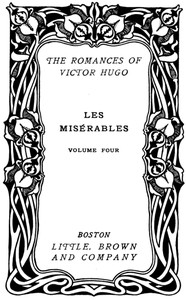
Les Misérables, v. 4/5: The Idyll and the Epic — Themes and Context
(0 User reviews)
672
Project Gutenberg
2015
Not confirmed
Historical fiction; Orphans -- Fiction; Paris (France) -- Fiction; Epic literature; Ex-convicts -- Fiction
Readers of public-domain and historical texts
Project Gutenberg digital edition
en
Edition facts
Words
129,152
Reading time
562 min
Text sections
11
For Les Misérables, v. 4/5: The Idyll and the Epic — Themes and Context, the stored edition analysis reports 129,152 words, 9 hr 22 min estimated reading time, and 11 detected text sections.
The text analysis averages about 20.7 words per sentence, while the detected sections provide another way to judge how the source is divided.
Project Gutenberg metadata also associates the work with “Historical fiction,” connecting these edition facts with the source record’s subject description.
Source:
Project Gutenberg record #48734
This volume of Hugo's epic pairs a detailed study of Parisian slang with the escalating rebellion of 1832, showing how language and insurgency both emerge from the city's depths.
Read the complete public-domain text at its original source.
Read on Project GutenbergThe fourth volume of Les Misérables opens not with a character but with a history of the July Monarchy, then descends into a lengthy disquisition on slang—its origins, its metaphors, and its role as the speech of the damned. Hugo treats slang as a living archive of suffering and resistance, claiming that “the whole of slang … is penetrated by that gloomy symbolic spirit.” This editorial note examines how the catalog subjects—historical fiction, epic literature, ex-convicts—intersect with the actual content of the excerpts, which devote surprising space to linguistic analysis and urban insurrection.
Slang as Social Archive
In Book VII, Hugo devotes three chapters to slang, tracing its roots to prisons and galleys. He asserts that “slang is the word converted into a convict” and that studying it reveals “the point of intersection of regular with accursed society.” The excerpts include a detailed etymology of camoufle (candle) and a claim that slang songs were born in the dungeon of the Great Châtelet. This material is not incidental; it forms a sustained argument that criminal language encodes collective memory. Hugo even quotes a galley chorus—“Timaloumisaine, timoulamison”—to illustrate how rhythm persists where hope fails. The catalog subject “ex-convicts” is thus reframed: the book is less about individual ex-convicts than about the linguistic world they inhabit.
The Epic in the Streets
The volume’s subtitle, “The Idyll and the Epic,” promises a contrast between private romance and public upheaval. The table of contents confirms this structure: the Rue Plumet idyll (Books II–VI) gives way to the Rue Saint-Denis epic (Books X–XIV). Yet the excerpts show Hugo treating the 1832 uprising as a historical set piece, complete with a chapter on “The Surface of the Question” and “The Bottom of the Question.” The catalog subject “epic literature” is apt, but the epic here is not a single hero’s journey; it is the collective action of insurgents, atomized into vignettes like Gavroche’s march and the barricade at Corinth. Hugo’s narrator repeatedly steps back to deliver panoramic views of Paris, as in “An Owl’s-Eye View of Paris,” blending topography with destiny.
Historical Fiction’s Documentary Impulse
The catalog classifies this as “historical fiction,” and the excerpts bear this out—but with a twist. Book I, “Some Pages of History,” includes a portrait of Louis Philippe and an analysis of “Cracks in the Foundation.” Hugo does not merely set a scene; he argues for a theory of revolution, claiming that “the ebullitions of other days” recur in new forms. The excerpts also reveal a documentary habit: the slang chapters cite specific prison songs, the barricade chapters name real streets (Rue des Billettes), and the narrative pauses to explain the origin of the word camouflet. This is historical fiction that insists on its own factuality, blurring the line between novel and treatise. Readers should expect digressions that function as footnotes to the action.
This volume rewards readers who attend to its digressions. The slang chapters, the historical summaries, and the topographical descriptions are not padding; they are the book’s argument that language, space, and rebellion are inseparable. Approach the text as a hybrid—part novel, part essay—and let Hugo’s footnotes guide you through the streets of 1832 Paris.
I found myself thinking about Les Misérables again, the way slang and barricades rise from the same gutters, and it drifted me to Barry Lyndon — Story, Setting & Ideas. Both are so rooted in ruin—one in Paris’s mud, the other in a gambler’s dwindling luck. A certain hunger for place clings to them both, quiet and unsolved.
There are no reviews for this eBook.
There are no comments for this eBook.
Reader reflection
Record your reading impressions
A brief reflection can help important ideas stay with you longer.
Your progress
0
/
10
2
Was reading this book enjoyable?
3
How likely are you to recommend this book?
4
How easy was the book to follow?
5
How closely did the book connect with your experience?
6
How valuable was this book for your own interests?
7
Was the book moving at the right speed?
8
Could you follow the author’s main argument?
9
What is the main idea you are taking away?
10