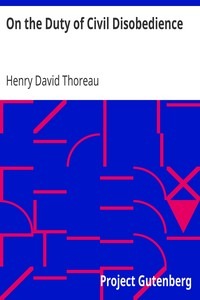
On the Duty of Civil Disobedience by Henry David Thoreau

(17 User reviews)   7329
By Jacob Brown Posted on Dec 22, 2025
In Category - Time Travel
Thoreau, Henry David, 1817-1862 Thoreau, Henry David, 1817-1862
English
Hey, I just read this short, fiery essay that feels like it was written yesterday, not in 1849. It’s about what you do when your government is doing something you know is deeply wrong. Thoreau wrote it after spending a night in jail for refusing to pay a tax that supported slavery and an unjust war. The core question is simple but powerful: Is it better to follow an unjust law, or to break it and accept the consequences? It's less of a story and more of a direct challenge to your conscience. If you've ever felt frustrated with politics or wondered where the line is between being a good citizen and being a moral person, this 50-page punch will give you a lot to think about.
Share

Read "On the Duty of Civil Disobedience by Henry David Thoreau" Online

This book is available in the public domain. Start reading the digital edition below.

START READING FULL BOOK
Instant Access    Mobile Friendly

Book Preview

A short preview of the book’s content is shown below to give you an idea of its style and themes.

liable to be abused and perverted before the people can act through it. Witness the present Mexican war, the work of comparatively a few individuals using the standing government as their tool; for, in the outset, the people would not have consented to this measure. This American government,—what is it but a tradition, though a recent one, endeavoring to transmit itself unimpaired to posterity, but each instant losing some of its integrity? It has not the vitality and force of a single living man; for a single man can bend it to his will. It is a sort of wooden gun to the people themselves; and, if ever they should use it in earnest as a real one against each other, it will surely split. But it is not the less necessary for this; for the people must have some complicated machinery or other, and hear its din, to satisfy that idea of government which they have. Governments show thus how successfully men can be imposed on, even impose on themselves, for their own advantage. It is excellent, we must all allow; yet this government never of itself furthered any enterprise, but by the alacrity with which it got out of its way. _It_ does not keep the country free. _It_ does not settle the West. _It_ does not educate. The character inherent in the American people has done all that has been accomplished; and it would have done somewhat more, if the government had not sometimes got in its way. For government is an expedient, by which men would fain succeed in letting one another alone; and, as has been said, when it is most expedient, the governed are most let alone by it. Trade and commerce, if they were not made of India rubber, would never manage to bounce over obstacles which legislators are continually putting in their way; and, if one were to judge these men wholly by the effects of their actions, and not partly by their intentions, they would deserve to be classed and punished with those mischievous persons who put obstructions on the railroads. But, to speak practically and as a citizen, unlike those who call themselves no-government men, I ask for, not at once no government, but _at once_ a better government. Let every man make known what kind of government would command his respect, and that will be one step toward obtaining it. After all, the practical reason why, when the power is once in the hands of the people, a majority are permitted, and for a long period continue, to rule, is not because they are most likely to be in the right, nor because this seems fairest to the minority, but because they are physically the strongest. But a government in which the majority rule in all cases can not be based on justice, even as far as men understand it. Can there not be a government in which the majorities do not virtually decide right and wrong, but conscience?—in which majorities decide only those questions to which the rule of expediency is applicable? Must the citizen ever for a moment, or in the least degree, resign his conscience to the legislator? Why has every man a conscience, then? I think that we should be men first, and subjects afterward. It is not desirable to cultivate a respect for the law, so much as for the right. The only obligation which I have a right to assume, is to do at any time what I think right. It is truly enough said that a corporation has no conscience; but a...

This is a limited preview. Download the book to read the full content.

This isn't a novel with characters and a plot. It's a personal essay born from Henry David Thoreau's own act of protest. He refused to pay his poll tax as a way of saying 'no' to a government that allowed slavery and was waging what he saw as an aggressive war in Mexico. For this, he was jailed for a night. The essay is his explanation of why he did it and why he thinks more people should consider similar acts of conscience.

Why You Should Read It

What shocked me is how modern it feels. Thoreau argues that we can't just vote and hope for the best; we have a direct responsibility for what our government does with our money and our implied consent. His idea that 'the only obligation I have a right to assume is to do at any time what I think right' is both thrilling and scary. It makes you examine your own life. How complicit are we in things we say we disagree with? It’s a call to align your actions with your beliefs, no matter how inconvenient.

Final Verdict

This is a must-read for anyone interested in activism, ethics, or political philosophy. It's the foundational text for peaceful protest that inspired Gandhi and Martin Luther King Jr. But you don't need to be a scholar to get value from it. If you’re a person who questions authority, values individual conscience, or has ever felt a knot in your stomach about 'just following orders,' this book is for you. It's short, dense, and guaranteed to spark a debate with yourself. Keep a highlighter handy—you'll need it.


📜 No Rights Reserved

This text is dedicated to the public domain. Preserving history for future generations.

Brian Martin
1 year ago

A must-have for anyone studying this subject.

David Scott
1 year ago

Citation worthy content.

Ashley Ramirez
9 months ago

My professor recommended this, and I see why.

Carol Martinez
2 years ago

Five stars!

John Nguyen
2 weeks ago

This book was worth my time since it provides a comprehensive overview perfect for everyone. Definitely a 5-star read.

5
5 out of 5 (17 User reviews )

Add a Review

Your Rating *
There are no comments for this eBook.
You must log in to post a comment.
Log in


Related eBooks