1

One Against the Moon — Context and Discussion
(0 User reviews)
940
Project Gutenberg
2015
Not confirmed
Science fiction; Extraterrestrial beings -- Fiction; Moon -- Fiction; Robinsonades; Stowaways -- Fiction
Readers of public-domain and historical texts
Project Gutenberg digital edition
en
Edition facts
Words
53,785
Reading time
234 min
Text sections
5
The source record for One Against the Moon — Context and Discussion measures this digital text at 53,785 words, 3 hr 54 min estimated reading time, and 5 detected text sections.
The text analysis averages about 15.0 words per sentence, while the detected sections provide another way to judge how the source is divided.
Project Gutenberg metadata also associates the work with “Science fiction,” connecting these edition facts with the source record’s subject description.
Source:
Project Gutenberg record #50713
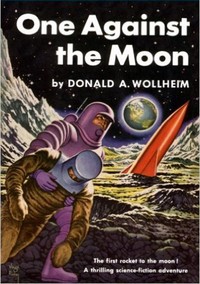
A young man named Robin Carew, a stowaway on a Moon rocket, must survive alone on the lunar surface using ingenuity and grit. The novel contrasts cramped Earth life with the Moon's harsh, diamond-strewn wilderness, where he encounters one-eyed, glass-skinned beings and builds a new existence from scratch.
Read the complete public-domain text at its original source.
Read on Project GutenbergThe novel opens with a precise, almost mundane Monday morning: Robin Carew wakes to a tinny alarm, yawns his five-foot-three frame, and stares into a tarnished mirror. This ordinary routine—a walk in the park, a library book on astronomy—is sharply undercut by his longing for the stars, which he fears will remain “just a daydream.” The contrast between the cramped YMCA washroom and the vast heavens sets up a central tension: the gap between aspiration and circumstance. Wollheim grounds the fantastic in the quotidian, making Robin’s later leap into space feel earned rather than arbitrary.
From YMCA to Lunar Cave
The story’s structure hinges on a dramatic shift in setting. The first chapters are confined to Earth—Robin’s boarding house, his job, the rocket port—but once he stows away, the narrative opens onto the Moon’s barren, volcanic landscape. The transition is abrupt: from the “tinny jangling” of an alarm clock to the silence of a crater floor. Wollheim uses this contrast to emphasize isolation. On Earth, Robin is one of many; on the Moon, he is utterly alone, forced to rebuild from scratch. The cave he finds becomes a second home, a primitive shelter that echoes the YMCA room but stripped of all comfort. This movement from the familiar to the alien is the novel’s backbone, each step forward a further removal from the world he knew.
The Diamond Spear and the One-Eyed Moonman
Recurring images of glass and diamond dominate the lunar sections. When Robin first captures a Moon creature, he notices its spear tip is “a single six-inch-long shard of diamond”—a detail that grounds the alien environment in material reality. The Moonmen are described as “semi-transparent,” with triangular heads and a single eye, topped by a “large yellow light bulb.” These visual motifs—glass, transparency, sharp edges—recur in descriptions of the landscape: volcanic rock, crystalline formations, and the “misty” quality of native life. Wollheim uses these images to create a coherent, tactile world. The diamond spear is not just a curiosity; it becomes a tool for survival, a symbol of how the Moon’s resources can be repurposed. Robin’s realization that “such a chunk brought back to Earth might be worth an emperor’s ransom” underscores the gulf between earthly value and lunar necessity.
Cooking Meat and Building Trust
One of the novel’s most effective sequences involves Robin luring a Moonman with roasted meat. The scene is a miniature lesson in cross-species communication: Robin fans smoke from his cave, hides, and waits. When the creature enters, Robin blocks the entrance, and a physical struggle ensues. But the turning point is not violence—it is sharing food. “Only friends would share a meal,” Robin thinks, a gesture he believes “would hold true anywhere in the universe.” This moment of trust is built on small, concrete actions: cutting meat, holding it out, eating together. Wollheim avoids grand speeches; instead, he lets the shared meal do the work. The creature’s curiosity mirrors Robin’s own, and the exchange of objects—spear for sack—becomes a silent negotiation. The scene is a model of how the novel builds relationships through practical, observed behavior rather than exposition.
The Long Trek Across the Crater Floor
Movement across the lunar surface is a recurring structural element. Chapter titles like “The Long Trek” and “On the Crater Floor” signal that travel is both literal and thematic. Robin’s journey is not a straight line; it involves detours, traps, and encounters. The Moon’s geography—craters, caves, volcanic plains—shapes the narrative’s pace. Wollheim uses the trek to introduce new challenges: the “Glass Man,” the “Man From Lake Baikal,” and the “Getaway Bomb.” Each chapter adds a layer of complexity, but the underlying rhythm remains constant: Robin moves, adapts, survives. The final chapters, “Moon Calling Earth” and “Madman’s Battle,” suggest a climax that involves communication and conflict, but the excerpts leave the resolution unclear. What is evident is that the journey itself, not the destination, drives the story forward.
Robinson Crusoe on the Moon
The catalog lists “Robinsonades” as a subject, and the novel wears this influence openly. Chapter 8 is titled “Robinson Crusoe Carew,” and Robin’s situation—stranded, forced to improvise—echoes Defoe’s castaway. But Wollheim adapts the template to a science-fiction context: instead of a desert island, Robin has a crater; instead of Friday, he befriends a one-eyed Moonman. The novel’s structure mirrors the Robinsonade’s episodic nature: each chapter presents a new problem (finding food, building shelter, dealing with natives) and a solution derived from ingenuity. The difference is the setting: the Moon’s low gravity, diamond deposits, and glass-skinned life forms require Robin to rethink survival from scratch. The novel is less about space travel than about the universal human capacity to adapt, a theme that resonates beyond its 1950s origins.
Readers approaching One Against the Moon should pay attention to the small details: the weight of a diamond spear, the texture of a Moonman’s skin, the way smoke curls in a cave. Wollheim’s strength lies in these concrete observations, which make the fantastic feel plausible. The novel rewards those who read for craft rather than plot twists. It is a quiet, methodical story about survival, told through the lens of a young man who never stops looking at the stars.
Reading about Robin making a home from the Moon’s rubble, I remembered the quiet joy of finishing Harold and feeling the weight of a lost world settle into me. Both books made solitude feel less like emptiness and more like a chance to listen. That strange companionship across centuries lingers. Harold : the Last of the Saxon Kings — Volume 06 — Edition Insights held a similar hush, a patient reckoning with what remains when everything familiar falls away.
There are no reviews for this eBook.
There are no comments for this eBook.
Reader reflection
Take a moment to reflect on this book
Create a short personal record of your experience with this book.
Your progress
0
/
10
2
How much did you enjoy the reading experience?
3
Would you recommend this book to another reader?
4
How demanding did the text feel?
5
Did anything about the book feel genuinely new?
6
Which element worked best for you?
7
How did the pace of the book feel?
8
Is this a title worth rereading?
9
In one sentence, what did you learn?
10