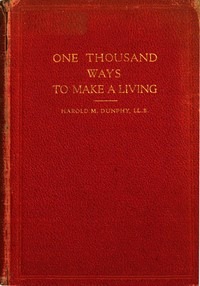
One Thousand Ways to Make a Living; or, An Encyclopædia of Plans to Make Money

(13 User reviews)   5332
By Jacob Brown Posted on Dec 22, 2025
In Category - Alien Worlds
Dunphy, Harold Morse Dunphy, Harold Morse
English
Ever feel like you're just one good idea away from financial freedom? That's exactly the promise of this quirky 1930s time capsule I just read. It's not a novel—it's a massive list of 1,000 money-making schemes, from the practical (starting a small farm) to the bizarre (raising frogs for laboratories). The real conflict isn't in a plot, but in the tension between the book's optimistic, can-do spirit and the harsh reality of the Great Depression it was born in. Reading it feels like peeking into the desperate, hopeful minds of a generation trying to hustle their way out of poverty. It's equal parts inspiring, heartbreaking, and utterly fascinating.
Share

Read "One Thousand Ways to Make a Living; or, An Encyclopædia of Plans to Make Money" Online

This book is available in the public domain. Start reading the digital edition below.

START READING FULL BOOK
Instant Access    Mobile Friendly

Book Preview

A short preview of the book’s content is shown below to give you an idea of its style and themes.

More transcriber’s notes may be found at the end of this text. [Illustration: HAROLD M. DUNPHY, LL. B. _Graduate of the University of Michigan, 1906_ _Attorney at Law_] ONE THOUSAND WAYS TO MAKE A LIVING OR AN ENCYCLOPÆDIA OF PLANS TO MAKE MONEY _Collated and Edited by_ HAROLD M. DUNPHY, LL. B. _FIRST EDITION_ SPOKANE, WASHINGTON 1919 ALL RIGHTS RESERVED, INCLUDING THAT OF TRANSLATION INTO FOREIGN LANGUAGES COPYRIGHT, 1919 BY H. M. DUNPHY SPOKANE, WASHINGTON IMPORTANT PUBLISHER’S ANNOUNCEMENT The contents of this book have taken years to gather. They have been collected from every corner of this vast continent, and in some cases from Europe. The literary style, no doubt, from the reviewer’s point of view, will leave much to be desired. This, from the very start, was pointed out to the editor, Mr. H. M. Dunphy, who, however, determined that his object was to give a plain, unvarnished story of how to make a livelihood, and not to produce a book of a high literary character. His exact words every time were: “My position as editor of this work is simply to take the matter as handed in to me from time to time, see that nothing objectionable or prohibited by the States laws is allowed to be published. So far as the literary style is concerned, it would not be difficult for me, a lawyer of long practice, to fall into line with the orthodox. But I prefer to give the different information just as sent in to me, with certain exceptions I have mentioned. “I did not arrive at this decision in haste, but after due deliberation. It was a choice of altering--and placing almost every experience I received--into literary phraseology, or allowing same to pass for publication in the language of the people. I choose the latter.” We think Mr. Dunphy is right. This book’s aim is the people rather than the classes; although we have no doubt it will appeal to many people of high education with slender means. However, the language in every case is understandable by the people, so, while no excuse is offered, we think the reviewers and the higher educated public should be given an explanation. Not only from a business point of view, but for the betterment of the conditions of the people, we desire this work to have a wide circulation. There is no need for people to call aloud about lack of employment if they will not consult this book. One way to make a livelihood has been omitted in the edition of this work, and we feel sure he will excuse us for drawing attention to the fact. We want agents in every part of the country--and we don’t want those agents to handle the work without proper compensation. Write us for terms. PREFACE The title of this book speaks for itself and should require no foreword from me. However, the able compiler and editor thinks otherwise, so I gladly fall in with his wishes. I grasp the opportunity, because I think when doing so, I can benefit a great number of my fellow-countrymen and country-women, who to-day have the constant shadow of unemployment confronting them. This is not a “get-rich-quick” book. It is a work to teach people how to get a livelihood. Of course, a great many people who commence in business through reading this book, and adopting one or more of the plans, will naturally push ahead and accumulate wealth. That, however, is not the object of the book. If it were, I certainly should not sponsor its sale. I maintain, as all decent...

This is a limited preview. Download the book to read the full content.

The Story

There's no traditional story here. Think of it as a giant, organized brainstorm from 1931. Author Harold Morse Dunphy compiled what he believed were 1,000 viable paths to income. The book is structured like a reference guide, with entries ranging from straightforward jobs ("Be a Bookkeeper," "Open a Tea Room") to niche ventures that make you do a double-take ("Collecting and Selling Caterpillars," "Manufacturing Artificial Eyes"). It's a raw snapshot of pre-digital entrepreneurship, where making a living often meant making something with your hands or filling a hyper-local need.

Why You Should Read It

This book is a history lesson disguised as a self-help manual. You won't find get-rich-quick schemes, but you will find a powerful reminder of human resilience. The sheer volume and variety of ideas are staggering. It makes you appreciate how much the world of work has changed, but also how the core desire to be self-sufficient and creative remains. I found myself equally amused by the outdated suggestions and genuinely impressed by the timeless ingenuity on display. It's less about following the plans today and more about absorbing its spirit of possibility.

Final Verdict

Perfect for history lovers, fans of oddball non-fiction, and anyone who enjoys browsing old catalogs or almanacs. If you're looking for a linear narrative, this isn't it. But if you want a thought-provoking, conversation-starting glimpse into the American psyche during economic crisis, this book is a unique and compelling read. Just don't quit your day job to start a caterpillar farm.


🏛️ Legal Disclaimer

This text is dedicated to the public domain. It is now common property for all to enjoy.

Christopher Thomas
2 years ago

Finally found time to read this!

Edward Hill
1 year ago

I stumbled upon this title and the pacing is just right, keeping you engaged. I will read more from this author.

Barbara Lee
3 months ago

Very helpful, thanks.

Thomas Martin
5 months ago

Perfect.

James Clark
1 year ago

This is one of those stories where it provides a comprehensive overview perfect for everyone. Truly inspiring.


4.5
4.5 out of 5 (13 User reviews )

Add a Review

Your Rating *
There are no comments for this eBook.
You must log in to post a comment.
Log in


Related eBooks