Primitive culture, vol. 2 (of 2) : Researches into the development of…

(13 User reviews)   4826
By Jacob Brown Posted on Jan 13, 2026
In Category - Hard Sci-Fi
Tylor, Edward B. (Edward Burnett), 1832-1917 Tylor, Edward B. (Edward Burnett), 1832-1917
English
Ever wonder why so many cultures, separated by oceans and centuries, share similar myths, rituals, or even games? That's the puzzle Edward Burnett Tylor tackles in 'Primitive Culture.' Forget dusty old theories about lost tribes or divine gifts. Tylor, a founding figure in anthropology, argues for a simpler, more radical idea: human minds everywhere work in similar ways, leading to similar inventions. This book is his grand tour of the evidence, from why people believe in souls to the surprising logic behind ancient superstitions. It’s not just about 'primitive' people; it’s a mirror held up to all of us, asking how our own beliefs and customs might have started. Reading it feels like watching someone solve a massive, global detective story, one clue at a time. If you've ever been curious about the 'why' behind the strange and familiar things humans do, this is your starting point.
Share

Read "Primitive culture, vol. 2 (of 2) : Researches into the development of…" Online

This book is available in the public domain. Start reading the digital edition below.

START READING FULL BOOK
Instant Access    Mobile Friendly

Book Preview

A short preview of the book’s content is shown below to give you an idea of its style and themes.

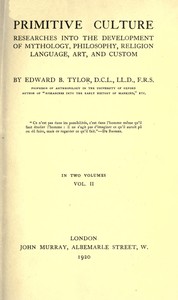
AUTHOR OF “RESEARCHES INTO THE EARLY HISTORY OF MANKIND,” ETC. “Ce n’est pas dans les possibilités, c’est dans l’homme même qu’il faut étudier l’homme: il ne s’agit pas d’imaginer ce qu’il auroit pû ou dû faire, mais de regarder ce qu’il fait.”—DE BROSSES. IN TWO VOLUMES VOL. II LONDON JOHN MURRAY, ALBEMARLE STREET, W. 1920 PRINTED IN U.S.A. [_Rights of Translation and Reproduction reserved_] CONTENTS OF THE SECOND VOLUME. CHAPTER XII. ANIMISM (_continued_). Doctrine of Soul’s Existence after Death; its main divisions, Transmigration and Future Life—Transmigration of Souls: re-birth in Human and Animal Bodies, transference to Plants and Objects—Resurrection of Body: scarcely held in savage religion—Future Life: a general if not universal doctrine of low races—Continued existence, rather than Immortality; second death of Soul—Ghost of Dead remains on earth, especially if corpse unburied; its attachment to bodily remains—Feasts of the Dead 1 CHAPTER XIII. ANIMISM (_continued_). Journey of the Soul to the Land of the Dead—Visits by the Living to the Regions of Departed Souls—Connexion of such legends with myths of Sunset: the Land of the Dead thus imagined as in the West—Realization of current religious ideas, whether of savage or civilized theology, in narratives of visits to the Regions of Souls—Localization of the Future Life—Distant earthly region: Earthly Paradise, Isles of the Blest—Subterranean Hades or Sheol—Sun, Moon, Stars—Heaven—Historical course of belief as to such localization—Nature of Future Life—Continuance-theory, apparently original, belongs especially to the lower races—Transitional theories—Retribution-theory, apparently derived, belongs especially to the higher races—Doctrine of Moral Retribution as developed in the higher culture—Survey of Doctrine of Future State, from savage to civilized stages—Its practical effect on the sentiment and conduct of Mankind 44 CHAPTER XIV. ANIMISM (_continued_). Animism, expanding from the Doctrine of Souls to the wider Doctrine of Spirits, becomes a complete Philosophy of Natural Religion—Definition of Spirits similar to and apparently modelled on that of Souls—Transition-stage: classes of Souls passing into good and evil Demons—Manes-Worship—Doctrine of Embodiment of Spirits in human, animal, vegetable, and inert bodies—Demoniacal Possession and Obsession as causes of Disease and Oracle-inspiration—Fetishism—Disease-spirits embodied—Ghost attached to remains of Corpse—Fetish produced by a Spirit embodied in, attached to, or operating through, an Object—Analogues of Fetish-doctrine in Modern Science—Stock-and-Stone-Worship—Idolatry—Survival of Animistic Phraseology in modern Language—Decline of Animistic theory of Nature 108 CHAPTER XV. ANIMISM (_continued_). Spirits regarded as personal causes of Phenomena of the World—Pervading Spirits as good and evil Demons affecting man—Spirits manifest in Dreams and Visions: Nightmares; Incubi and Succubi; Vampires; Visionary Demons—Demons of darkness repelled by fire—Demons otherwise manifest: seen by animals; detected by footprints—Spirits conceived and treated as material—Guardian and Familiar Spirits—Nature-Spirits; historical course of the doctrine—Spirits of Volcanos, Whirlpools, Rocks—Water-Worship: Spirits of Wells, Streams, Lakes, &c.—Tree-Worship: Spirits embodied in or inhabiting Trees; Spirits of Groves and Forests—Animal-worship: Animals Worshipped, directly, or as incarnations or representatives of Deities; Totemism; Serpent-Worship—Species-Deities; their relation to Archetypal Ideas 184 CHAPTER XVI. ANIMISM (_continued_). Higher Deities of Polytheism—Human characteristics applied to Deity—Lords of Spiritual Hierarchy—Polytheism: its course of development in lower and higher Culture—Principles of its investigation; classification of Deities according to central conceptions of their significance and function—Heaven-god—Rain god—Thunder-god—Wind-gods—Earth-god—Water god—Sea-god—Fire-god—Sun-god—Moon-god 247 CHAPTER XVII. ANIMISM (_continued_). Polytheism comprises a class of great Deities, ruling the course of Nature and the life of Man—Childbirth-god—Agriculture-god—War-god—God of the Dead—First Man as Divine Ancestor—Dualism; its rudimentary and unethical nature among low races; its development through the course of culture—Good and Evil Deity—Doctrine of Divine Supremacy, distinct from, while tending towards, the doctrine of Monotheism—Idea of a Highest or Supreme Deity evolved in various forms; its place as completion of the Polytheistic system and outcome of the Animistic philosophy; its continuance...

This is a limited preview. Download the book to read the full content.

Don't let the title 'Primitive Culture' fool you. This isn't a stuffy, judgmental catalog of 'simple' societies. Written in 1871, this book is a foundational text that helped create anthropology as we know it. Edward Burnett Tylor's goal is ambitious: to trace the development of human culture, from its earliest forms to modern civilization.

The Story

There isn't a plot in the traditional sense. Instead, think of it as a grand intellectual adventure. Tylor gathers stories, rituals, tools, and beliefs from cultures across the globe—from the Americas to Australia, from ancient history to his own Victorian England. He lines them up side-by-side, looking for patterns. Why do so many cultures have flood myths? Why do people make offerings to the dead? His central argument is the idea of 'survivals'—old habits and beliefs that stick around long after their original purpose is forgotten, like superstitions or children's games. He uses these survivals as clues to piece together the earlier stages of human thought.

Why You Should Read It

Reading Tylor today is a fascinating experience. You get to witness the birth of big ideas. His concept that all human societies are connected by a shared 'psychic unity' was revolutionary. It argued against racist theories of the time, suggesting that cultural differences come from different stages of development, not from different kinds of minds. While some of his Victorian-era assumptions feel dated now, the core of his method—comparison, looking for logical explanations, and treating all human cultures as worthy of study—is thrilling. It makes you look at your own world differently. That lucky charm on your keychain? The fairy tales you heard as a kid? Tylor would say they're survivals, tiny echoes of humanity's long, shared story.

Final Verdict

This is a book for the curious thinker, not the casual reader. It's perfect for anyone interested in the history of ideas, the roots of anthropology, or the origins of myths and religions. If you enjoy writers like James Frazer or Joseph Campbell, you'll meet one of their major influences here. Be prepared for dense, detailed passages, but the payoff is a profound shift in perspective. You won't just learn about 'other' cultures; you'll start questioning the ancient, often invisible, foundations of your own.


✅ Community Domain

This book is widely considered to be in the public domain. It is available for public use and education.

George Torres
6 months ago

Comprehensive and well-researched.

Joseph Nguyen
1 year ago

Great reference material for my coursework.

Sarah Lee
1 year ago

Read this on my tablet, looks great.

Ethan Rodriguez
1 year ago

The index links actually work, which is rare!

Carol Wilson
8 months ago

Finally found time to read this!

4.5
4.5 out of 5 (13 User reviews )

Add a Review

Your Rating *
There are no comments for this eBook.
You must log in to post a comment.
Log in


Related eBooks