
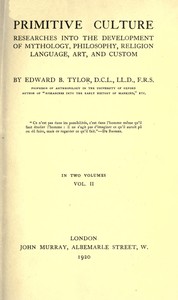
Primitive culture, vol. 2 (of 2) : Researches into the development of…
Read "Primitive culture, vol. 2 (of 2) : Researches into the development of…" Online
This book is available in the public domain. Start reading the digital edition below.
START READING FULL BOOKBook Preview
A short preview of the book’s content is shown below to give you an idea of its style and themes.
Don't let the title 'Primitive Culture' fool you. This isn't a stuffy, judgmental catalog of 'simple' societies. Written in 1871, this book is a foundational text that helped create anthropology as we know it. Edward Burnett Tylor's goal is ambitious: to trace the development of human culture, from its earliest forms to modern civilization.
The Story
There isn't a plot in the traditional sense. Instead, think of it as a grand intellectual adventure. Tylor gathers stories, rituals, tools, and beliefs from cultures across the globe—from the Americas to Australia, from ancient history to his own Victorian England. He lines them up side-by-side, looking for patterns. Why do so many cultures have flood myths? Why do people make offerings to the dead? His central argument is the idea of 'survivals'—old habits and beliefs that stick around long after their original purpose is forgotten, like superstitions or children's games. He uses these survivals as clues to piece together the earlier stages of human thought.
Why You Should Read It
Reading Tylor today is a fascinating experience. You get to witness the birth of big ideas. His concept that all human societies are connected by a shared 'psychic unity' was revolutionary. It argued against racist theories of the time, suggesting that cultural differences come from different stages of development, not from different kinds of minds. While some of his Victorian-era assumptions feel dated now, the core of his method—comparison, looking for logical explanations, and treating all human cultures as worthy of study—is thrilling. It makes you look at your own world differently. That lucky charm on your keychain? The fairy tales you heard as a kid? Tylor would say they're survivals, tiny echoes of humanity's long, shared story.
Final Verdict
This is a book for the curious thinker, not the casual reader. It's perfect for anyone interested in the history of ideas, the roots of anthropology, or the origins of myths and religions. If you enjoy writers like James Frazer or Joseph Campbell, you'll meet one of their major influences here. Be prepared for dense, detailed passages, but the payoff is a profound shift in perspective. You won't just learn about 'other' cultures; you'll start questioning the ancient, often invisible, foundations of your own.
This book is widely considered to be in the public domain. It is available for public use and education.
Joseph Nguyen
1 year agoGreat reference material for my coursework.
Sarah Lee
1 year agoRead this on my tablet, looks great.
Ethan Rodriguez
1 year agoThe index links actually work, which is rare!
Carol Wilson
8 months agoFinally found time to read this!





George Torres
6 months agoComprehensive and well-researched.