1

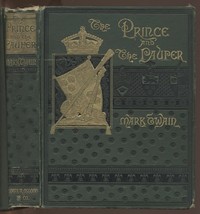
The Prince and the Pauper, Part 4. — Key Ideas to Explore
(0 User reviews)
30
Project Gutenberg
2004
Not confirmed
Historical fiction; London (England) -- Fiction; Impostors and imposture -- Fiction; Boys -- Fiction; Social classes -- Fiction; Princes -- Fiction; Edward VI, King of England, 1537-1553 -- Fiction; Poor children -- Fiction; Lookalikes -- Fiction
Readers of public-domain and historical texts
Project Gutenberg digital edition
en
Edition facts
Words
12,606
Reading time
55 min
Text sections
2
The Prince and the Pauper, Part 4. — Key Ideas to Explore can be approached with a clearer sense of reading commitment from its source measurements: 12,606 words, 55 min estimated reading time, and 2 detected text sections.
The text analysis averages about 23.2 words per sentence, while the detected sections provide another way to judge how the source is divided.
Project Gutenberg metadata also associates the work with “Historical fiction,” connecting these edition facts with the source record’s subject description.
Source:
Project Gutenberg record #7157
This editorial note examines the structure, recurring images, and movement between scenes in Part 4 of Mark Twain's The Prince and the Pauper, focusing on the ceremonial dressing of Tom Canty, the dream sequence, and the use of the bridge as a setting.
Read the complete public-domain text at its original source.
Read on Project GutenbergPart 4 of The Prince and the Pauper opens with a striking structural shift: the narrative voice steps back to frame the tale as a handed-down story, possibly legend, before plunging into the aftermath of King Henry VIII's death. The chapter titles—'The Prince and his deliverer,' 'The disappearance of the Prince,' and 'Le Roi est mort—vive le Roi'—signal a tripartite movement from rescue to loss to succession. Twain uses the London Bridge as a liminal space, a 'town to itself' that physically and symbolically connects the realms of the commoner and the court. The bridge's crowded shops and inhabitants create a bustling, almost claustrophobic atmosphere that contrasts sharply with the later scenes in the palace.
The Ceremonial Dressing as Structural Comedy
The dressing of Tom Canty as king is rendered through an elaborate, almost absurdly protracted chain of courtiers. Each garment passes through a dozen hands—from the Chief Equerry in Waiting to the Archbishop of Canterbury—before reaching Tom. Twain's repetition of the phrase 'who passed it to' creates a rhythmic, cumulative effect that mimics the tedium of the ritual. The comedy peaks when a missing tag on a hose sends the garment back through the entire line, accompanied by whispered exclamations of 'See, my lord!' This sequence not only satirizes courtly bureaucracy but also establishes a structural pattern: the narrative slows to a crawl, forcing the reader to experience Tom's weariness. The dressing becomes a microcosm of the rigid hierarchy that Tom must navigate, and the broken tag—a trivial defect—threatens to derail the entire process, highlighting the absurdity of such formality.
Dreams and Awakenings: The Shifting Thresholds of Reality
Twain repeatedly blurs the boundary between dream and waking. Tom's dream of returning to his mother with honestly earned pennies is shattered by the First Lord of the Bedchamber's voice: 'It waxeth late—may it please your Majesty to rise?' The dream's domestic warmth—the 'sordid home,' the mother's embrace—contrasts with the cold reality of the court. The phrase 'the gladness of the lying dream faded away' underscores the cruelty of the awakening. Similarly, the little prince (now king) hears the cry 'The King is dead!' and feels 'the most forlorn, outcast, and forsaken of God's creatures' before the counter-cry 'Long live King Edward the Sixth!' thrills him. These rapid oscillations between despair and pride, between the imagined and the real, structure the emotional arc of Part 4. The dream sequences are not mere interludes but active forces that shape the characters' perceptions of their identities.
The Bridge as a Liminal Space
London Bridge is depicted as a self-contained town, with 'its inn, its beer-houses, its bakeries, its haberdasheries, its food markets, its manufacturing industries, and even its church.' This description transforms the bridge from a mere thoroughfare into a microcosm of society, a place where the prince and his deliverer must 'plough into the multitude.' The bridge's six-hundred-year history and its dual nature—both a structure and a community—make it a fitting setting for the transition between the mob and the palace. Twain's attention to the bridge's shops and inhabitants grounds the fantastical plot in a tangible, historical London. The movement across the bridge is not just physical but symbolic: it marks the passage from the chaos of the streets to the order (and absurdity) of the court. The bridge also serves as a site of news dissemination, where the prince learns of his father's death and his own accession, linking public space to personal transformation.
The Handed-Down Tale: Narrative Framing and Authenticity
The opening paragraph of Part 4 introduces a narrative frame: the story is 'set down' as told by one who heard it from his father, and so on back 'three hundred years and more.' Twain explicitly acknowledges the uncertainty of the tale—'It may be history, it may be only a legend, a tradition. It may have happened, it may not have happened: but it COULD have happened.' This framing device distances the reader from the events, inviting a skeptical yet open-minded engagement. The phrase 'the wise and the learned believed it in the old days; it may be that only the unlearned and the simple loved it and credited it' suggests a tension between elite and popular reception. By foregrounding the story's transmission, Twain comments on the nature of historical truth and the role of oral tradition. This meta-narrative layer adds depth to the subsequent scenes, reminding the reader that what follows is a filtered account, not a transparent record.
Part 4 of The Prince and the Pauper rewards attention to its structural rhythms—the slow procession of the dressing, the sudden jolts of dream and awakening, and the movement across the bridge. Twain's use of repetition and contrast creates a texture that is both comic and poignant. Readers may find it useful to track how each scene shifts between the intimate and the ceremonial, and how the narrative frame colors the events that follow. The interplay between the legendary and the historical invites reflection on how stories about power and identity are shaped by their tellers.
Tom Canty’s ceremonial dressing feels less like triumph than a quiet loss of himself. I thought of that tender ache again while reading Marius the Epicurean — Volume 1 — Reading Notes, where beauty and ritual also wrap around a soul so gently they almost smother it. Twain’s bridge, too, stays with me—neither shore, just the holding between.
There are no reviews for this eBook.
There are no comments for this eBook.
Reader reflection
How did this book work for you?
Your answers remain private and are stored only in this browser.
Your progress
0
/
10
2
What was your overall reaction to the book?
3
Would you pass this book on to a friend?
4
How demanding did the text feel?
5
Did it raise ideas you would like to talk about?
6
Do you expect to return to this book?
7
How distinctive were its ideas or approach?
8
Which part made the strongest impression?
9
What is the main idea you are taking away?
10