
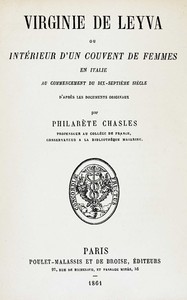
Virginie de Leyva : ou intérieur d'un couvent de femmes en Italie au…
Read "Virginie de Leyva : ou intérieur d'un couvent de femmes en Italie au…" Online
This book is available in the public domain. Start reading the digital edition below.
START READING FULL BOOKBook Preview
A short preview of the book’s content is shown below to give you an idea of its style and themes.
First published in the 19th century, Philarète Chasles's account feels surprisingly modern in its focus. He takes the scandalous true story of Virginia de Leyva—an Italian noblewoman forced into a convent in the late 1500s—and uses it as a lens to examine the entire world she was trapped in.
The Story
The plot follows Virginie from her reluctant entry into the convent of Monza. She's there against her will, and that resentment never fades. Instead, she navigates a complex social hierarchy where nuns jockey for influence, money and family name matter as much as faith, and strict rules hide simmering tensions. The narrative builds toward the infamous crime that made Virginie and her convent notorious: a murder orchestrated within the cloister itself. Chasles details not just the act, but the years of frustration, forbidden relationships, and toxic power dynamics that led to it. It's a slow burn that explodes into a public scandal, shaking the Church and society.
Why You Should Read It
What makes this book stick with you is its humanity. Chasles, for his time, shows a real interest in Virginie's psychology. She's not a villain or a saint; she's a complicated person reacting to an impossible situation. The book asks tough questions about agency, corruption, and what happens when institutions meant for salvation become prisons. Reading it, you get a sense of the claustrophobia, the gossip, the small rebellions, and the huge consequences. It's a powerful reminder that history's most dramatic stories often happened behind closed doors, to people who were supposed to be invisible.
Final Verdict
This is a perfect pick for readers who love historical nonfiction that feels like a novel. If you enjoyed books like The Nun by Denis Diderot or are fascinated by the darker, more human sides of religious history, you'll be hooked. It's also great for anyone interested in early true crime or stories about women fighting back against the rigid roles society gave them. Fair warning: it's a 19th-century text, so the style is a bit denser than a modern page-turner, but the story at its heart is utterly compelling. Dive in for a glimpse behind the veil you won't forget.
No rights are reserved for this publication. Knowledge should be free and accessible.
Mark Young
1 year agoWithout a doubt, the content flows smoothly from one chapter to the next. Exactly what I needed.
Andrew Lewis
3 months agoI came across this while browsing and it manages to explain difficult concepts in plain English. This story will stay with me.
Jessica Torres
1 year agoSolid story.
Nancy King
2 years agoEssential reading for students of this field.







Emma Brown
1 year agoTo be perfectly clear, the arguments are well-supported by credible references. Worth every second.