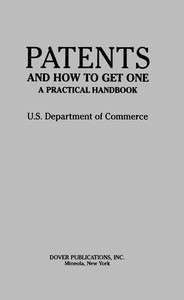
Patents and How to Get One: A Practical Handbook

(5 User reviews)   4427
By Jacob Brown Posted on Dec 22, 2025
In Category - Space Opera
United States. Department of Commerce United States. Department of Commerce
English
Hey, have you ever had a brilliant idea and wondered, 'Could I patent that?' I know I have. It feels like a total mystery. This book, straight from the U.S. Department of Commerce, is the official decoder ring. It's not a story about inventors, but the rulebook for becoming one. The main conflict? Your amazing idea versus a mountain of government paperwork and legal jargon. This handbook is your guide through that maze. It won't write your patent for you, but it will show you every single step, define every confusing term, and tell you exactly which forms you need and where to send them. Think of it as having a patient government expert sitting right next to you, explaining everything in plain English.
Share

Read "Patents and How to Get One: A Practical Handbook" Online

This book is available in the public domain. Start reading the digital edition below.

START READING FULL BOOK
Instant Access    Mobile Friendly

Book Preview

A short preview of the book’s content is shown below to give you an idea of its style and themes.

The Patent and Trademark Office (PTO) is an agency of the U.S. Department of Commerce. The role of the Patent and Trademark Office is to grant patents for the protection of inventions and to register trademarks. It serves the interest of inventors and businesses with respect to their inventions and corporate products, and service identifications. It also advises and assists the bureaus and offices of the Department of Commerce and other agencies of the Government in matters involving “intellectual property” such as patents, trademarks and semiconductor mask works. Through the preservation, classification, and dissemination of patent information, the Office aids and encourages innovation and the scientific and technical advancement of the nation. In discharging its patent related duties, the Patent and Trademark Office examines applications and grants patents on inventions when applicants are entitled to them; it publishes and disseminates patent information, records assignments of patents, maintains search files of U.S. and foreign patents, and maintains a search room for public use in examining issued patents and records. It supplies copies of patents and official records to the public. Similar functions are performed relating to trademarks. Purpose of this Booklet The purpose of this booklet is to give users some general information about patents and the operations of the Patent and Trademark Office. It attempts to answer many of the questions commonly asked of the Patent and Trademark Office but is not intended to be a comprehensive textbook on patent law or a guide for the patent attorney. It is hoped that this information will be useful to inventors and prospective applicants for patents, to students, and to others who may be interested in patents by giving them a brief general introduction to the subject. Additional information may be obtained from the publications listed under the sections “Publications of the Patent and Trademark Office” and “General information and correspondence.” Also, information is available on the U.S. Patent and Trademark Office’s Web site at: _http://www.uspto.gov_. The Patent and Trademark Office does not publish any textbooks on patent law, but a number of such works for the specialist and for the general reader have been published by private concerns. What Is a Patent? A patent for an invention is a grant of a property right by the Government to the inventor (or his or her heirs or assigns), acting through the Patent and Trademark Office. The term of the patent shall be 20 years from the date on which the application for the patent was filed in the United States or, if the application contains a specific reference to an earlier filed application under 35 U.S.C. 120, 121 or 365(c), from the date the earliest such application was filed, subject to the payment of maintenance fees. The right conferred by the patent grant extends only throughout the United States and its territories and possessions. The right conferred by the patent grant is, in the language of the statute and of the grant itself, “the right to exclude others from making, using, offering for sale, or selling” the invention in the United States or “importing” the invention into the United States. What is granted is not the right to make, use, offer for sale, sell or import, but the right to exclude others from making, using, offering for sale, selling or importing the invention. Most of the statements in the preceding paragraphs will be explained in greater detail in later sections. Some persons occasionally confuse patents, copyrights, and trademarks. Although there may be some resemblance in the rights of these three kinds of intellectual property, they are different and serve different purposes. Copyrights...

This is a limited preview. Download the book to read the full content.

Okay, let's be clear: this is not a novel. There's no plot twist or character arc. The 'story' here is the step-by-step journey of turning an idea into a protected piece of intellectual property.

The Story

The book walks you through the entire process from start to finish. It begins with the big question: 'Is my idea even patentable?' Then it guides you through searching existing patents so you don't reinvent the wheel. The real meat of the story is the application process itself—how to describe your invention, craft the claims (the legal heart of the patent), and navigate the examination by a patent officer. It ends with what happens after: maintenance fees, potential disputes, and your rights as a patent holder.

Why You Should Read It

I love this because it demystifies something that seems incredibly intimidating. The tone is surprisingly straightforward for a government document. It breaks down complex concepts without talking down to you. Reading it, I felt empowered, like I was being let in on a secret process. It replaces anxiety with a clear checklist. You won't find inspirational stories, but you will find immense practical value.

Final Verdict

This is the essential first stop for any aspiring inventor, DIY maker, or small business owner with a product idea. It's perfect for the person who is serious about protecting their creation and wants to understand the 'how' before hiring a lawyer (or to work better with one). If you're looking for a business thriller, look elsewhere. But if you need a reliable, official roadmap for the patent process, this handbook is invaluable.


🏛️ Open Access

This historical work is free of copyright protections. Knowledge should be free and accessible.

Ashley Anderson
1 year ago

I didn't expect much, but the pacing is just right, keeping you engaged. I would gladly recommend this title.

Joshua Lewis
1 year ago

Five stars!

Robert Walker
1 year ago

Fast paced, good book.

Lisa Williams
8 months ago

This is one of those stories where the pacing is just right, keeping you engaged. Absolutely essential reading.

Sarah White
1 year ago

Finally a version with clear text and no errors.

4.5
4.5 out of 5 (5 User reviews )

Add a Review

Your Rating *
There are no comments for this eBook.
You must log in to post a comment.
Log in


Related eBooks