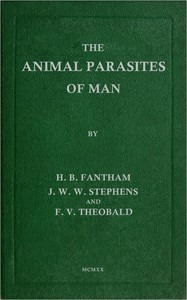
The Animal Parasites of Man by Fantham, Braun, Stephens, and Theobald

(15 User reviews)   5886
By Jacob Brown Posted on Dec 22, 2025
In Category - Space Opera
Theobald, Fred. V. (Frederick Vincent), 1868-1930 Theobald, Fred. V. (Frederick Vincent), 1868-1930
English
Imagine a book that reads like a medical detective story from a century ago. 'The Animal Parasites of Man' isn't a dry textbook—it's a systematic hunt for the tiny creatures that have lived with (and on) us throughout history. The authors act as guides, leading you through a hidden world of worms, flukes, and protozoa, explaining where they come from, how they survive, and what they do to their human hosts. It's a fascinating, slightly unsettling look at a part of nature we usually try to ignore, written with the urgency of early 20th-century science trying to solve real-world health mysteries. If you've ever been curious about the biology behind diseases like malaria or tapeworms, this is your historical field guide.
Share

Read "The Animal Parasites of Man by Fantham, Braun, Stephens, and Theobald" Online

This book is available in the public domain. Start reading the digital edition below.

START READING FULL BOOK
Instant Access    Mobile Friendly

Book Preview

A short preview of the book’s content is shown below to give you an idea of its style and themes.

to check the laws of the country where you are located before using this ebook. Title: The Animal Parasites of Man Author: H. B. Fantham J. W. W. Stephens F. V. Theobald Contributor: Max Braun Otto Seifert Release Date: August 17, 2018 [EBook #57713] Language: English Character set encoding: UTF-8 *** START OF THIS PROJECT GUTENBERG EBOOK THE ANIMAL PARASITES OF MAN *** Produced by Thiers Halliwell, Chris Curnow and the Online Distributed Proofreading Team at http://www.pgdp.net (This file was produced from images generously made available by The Internet Archive) Transcriber’s notes: The text of this e-book has mostly been preserved in its original form, including inconsistent italics, capitalisation, hyphenation and diacritics; however, some infelicities have been corrected silently, e.g. missing/inconsistent punctuation, parentheses and spacing. Several footnote markers have been inserted where they were missing from the text. The _very_ long table of contents has somewhat inconsistent levels of indentation that don’t correspond accurately with headings used in the text. Some illustrations have been moved nearer to the relevant text and their locations may differ from those specified in the list of illustrations. A few illustrations that lacked an identifying number have been correctly numbered. The book contains extensive sections of quoted text but these are identified by square brackets rather than by traditional quotation marks. Two different sized fonts were used to print the original body text, a feature that is replicated in this transcription. Several short passages of text were inserted by the printer at the last minute, and these are enclosed in lightly shaded text boxes. A list of spelling corrections and inconsistencies is appended at the end of the book. THE ANIMAL PARASITES OF MAN BY H. B. FANTHAM, M.A.Cantab., D.Sc.Lond. _Lecturer on Parasitology, Liverpool School of Tropical Medicine_; _Sectional Editor in Protozoology, “Tropical Diseases Bulletin,” London_, _etc._ J. W. W. STEPHENS, M.D.Cantab., D.P.H. _Sir Alfred Jones Professor of Tropical Medicine, Liverpool University, etc._ AND F. V. THEOBALD, M.A.Cantab., F.E.S., Hon. F.R.H.S. _Professor of Agricultural Zoology, London University_; _Vice- Principal and Zoologist of the South-eastern Agricultural College_; _Mary Kingsley Medallist_; _Grande Médaille Geoffroy St. Hilaire_, _Soc. Nat. d’Acclim. de France_, _etc._ PARTLY ADAPTED FROM Dr. MAX BRAUN’S “Die Tierischen Parasiten des Menschen” (4th Edition, 1908) and an Appendix by Dr. OTTO SEIFERT. NEW YORK WILLIAM WOOD AND COMPANY MCMXX. PREFACE. The English edition of Braun’s “Die Tierischen Parasiten des Menschen,” produced in 1906, being out of print, the publishers decided to issue another edition based on the translation of Braun’s fourth German edition, which appeared in 1908, to which had been added an appendix, by Dr. Otto Seifert on Treatment, etc. When the work was considered with a view to a new edition, it was found that a vast amount of new matter had to be incorporated, numerous alterations essential for bringing it up to date were necessitated, and many omissions were inevitable. The result is that parts of the book have been rewritten, and, apart from early historical references, the work of Braun has disappeared. This is more particularly the case with the Protozoa section of the present work. The numerous additions, due to the great output of scientific literature and other delays in publication, have led to the book being somewhat less homogeneous than we desired, and have necessitated the use of appendices to allow of the presentation of new facts only recently ascertained. Many new illustrations have been added or substituted for older, less detailed ones. Some of these new figures were drawn specially for this book. The first section, on the Protozoa, has been written by Dr. Fantham, there being little of...

This is a limited preview. Download the book to read the full content.

Let's be clear: this isn't a novel. There's no main character or plot twist in the traditional sense. Instead, the 'story' here is the meticulous cataloging and investigation of humanity's uninvited guests. The book is structured as a comprehensive guide, moving through different groups of parasites—from single-celled protozoa to complex tapeworms. For each, it details their life cycles, how they infect people, the symptoms they cause, and where in the world they're found. The narrative drive comes from the process of scientific discovery itself, piecing together the puzzle of these often-invisible threats.

Why You Should Read It

You should read it for the perspective. Published in the early 1900s, it captures a pivotal moment. Germ theory was still relatively new, and this book represents a massive effort to organize and communicate life-saving knowledge. Reading it, you feel the authors' mission to educate. There's a sobering reality to seeing all the ways our bodies can be invaded, but also a compelling respect for the science working to understand it. It turns something grotesque into a subject of genuine intrigue.

Final Verdict

This book is perfect for readers with a strong interest in medical history, biology, or the history of science. It's also great for anyone who enjoys primary sources that let you step directly into the mindset of a past era. Be warned: it is a technical work of its time, so it's not a light, casual read. But if you're looking to understand how scientists a century ago saw the invisible world living inside us, there are few books that offer such a direct and detailed window.


📚 Free to Use

The copyright for this book has expired, making it public property. You can copy, modify, and distribute it freely.

Elizabeth Ramirez
5 months ago

Perfect.

Mason Williams
1 year ago

Great read!

James Flores
5 months ago

Loved it.

Michael Nguyen
4 months ago

Simply put, the depth of research presented here is truly commendable. I learned so much from this.

Thomas Rodriguez
1 year ago

Not bad at all.

4.5
4.5 out of 5 (15 User reviews )

Add a Review

Your Rating *
There are no comments for this eBook.
You must log in to post a comment.
Log in


Related eBooks