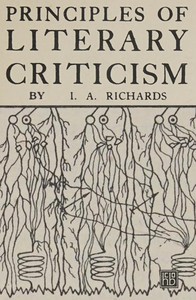
Principles of literary criticism by I. A. Richards

(6 User reviews)   3698
By Jacob Brown Posted on Jan 3, 2026
In Category - Space Opera
Richards, I. A. (Ivor Armstrong), 1893-1979 Richards, I. A. (Ivor Armstrong), 1893-1979
English
Ever read a poem and wonder why it makes you feel a certain way? Or why some writing feels powerful while other stuff just falls flat? I.A. Richards wrote 'Principles of Literary Criticism' to answer those exact questions. Forget dusty old rules about what's 'good' or 'bad' art. This book is like getting a backstage pass to how literature actually works on your mind and emotions. It's not always an easy read, but if you've ever wanted to understand the mechanics behind the magic of great writing, this is your starting point. Think of it as the owner's manual for your reading brain.
Share

Read "Principles of literary criticism by I. A. Richards" Online

This book is available in the public domain. Start reading the digital edition below.

START READING FULL BOOK
Instant Access    Mobile Friendly

Book Preview

A short preview of the book’s content is shown below to give you an idea of its style and themes.

painting, sculpture, and music form the subjects of three chapters. Another important chapter deals with the availability of the poet’s experience.”—_The Criterion, London_. “Mr. Richards is an entertaining writer, whose work avoids easily the tedium of a technical treatise.”—_The British Journal of Psychology_. Transcriber’s Note: This eBook was created from a 1928 edition, scans of which are available from the Internet Archive. Tildes (~) indicate words that were set in Fraktur script in the original text. New original cover art included with this eBook is granted to the public domain. International Library of Psychology Philosophy and Scientific Method PRINCIPLES OF LITERARY CRITICISM BY I. A. RICHARDS FELLOW OF MAGDALENE COLLEGE, CAMBRIDGE NEW YORK HARCOURT, BRACE AND COMPANY LONDON: KEGAN PAUL, TRENCH, TRUBNER & CO. LTD. PRINTED IN GREAT BRITAIN BY LUND HUMPHRIES LONDON · BRADFORD CONTENTS I. THE CHAOS OF CRITICAL THEORIES II. THE PHANTOM ÆSTHETIC STATE III. THE LANGUAGE OF CRITICISM IV. COMMUNICATION AND THE ARTIST V. THE CRITICS’ CONCERN WITH VALUE VI. VALUE AS AN ULTIMATE IDEA VII. A PSYCHOLOGICAL THEORY OF VALUE VIII. ART AND MORALS IX. ACTUAL AND POSSIBLE MISAPPREHENSIONS X. POETRY FOR POETRY’S SAKE XI. A SKETCH FOR A PSYCHOLOGY XII. PLEASURE XIII. EMOTION AND THE CŒNESTHESIA XIV. MEMORY XV. ATTITUDES XVI. THE ANALYSIS OF A POEM XVII. RHYTHM AND METRE XVIII. ON LOOKING AT A PICTURE XIX. SCULPTURE AND THE CONSTRUCTION OF FORM XX. THE _IMPASSE_ OF MUSICAL THEORY XXI. A THEORY OF COMMUNICATION XXII. THE AVAILABILITY OF THE POET’S EXPERIENCE XXIII. TOLSTOY’S INFECTION THEORY XXIV. THE NORMALITY OF THE ARTIST XXV. BADNESS IN POETRY XXVI. JUDGMENT AND DIVERGENT READINGS XXVII. LEVELS OF RESPONSE AND THE WIDTH OF APPEAL XXVIII. THE ALLUSIVENESS OF MODERN POETRY XXIX. PERMANENCE AS A CRITERION XXX. THE DEFINITION OF A POEM XXXI. ART, PLAY, AND CIVILISATION XXXII. THE IMAGINATION XXXIII. TRUTH AND REVELATION THEORIES XXXIV. THE TWO USES OF LANGUAGE XXXV. POETRY AND BELIEFS APPENDIX A ON VALUE APPENDIX B ON MR. ELIOT’S POETRY PREFACE A book is a machine to think with, but it need not, therefore, usurp the functions either of the bellows or the locomotive. This book might better be compared to a loom on which it is proposed to re-weave some ravelled parts of our civilisation. What is most important about it, the interconnection of its several points of view, might have been exhibited, though not with equal clarity, in a pamphlet or in a two-volume work. Few of the separate items are original. One does not expect novel cards when playing so traditional a game; it is the hand which matters. I have chosen to present it here on the smallest scale which would allow me to fit together the various positions adopted into a whole of some firmness. The elaborations and expansions which suggest themselves have been constantly cut short at the point at which I thought that the reader would be able to see for himself how they would continue. The danger of this procedure, which otherwise has great advantages both for him and for me, is that the different parts of a connected account such as this mutually illumine one another. The writer, who has, or should have, the whole position in his mind throughout, may overlook sources of obscurity for the reader, due to the serial form of the exposition. This I have endeavoured to prevent by means of numerous cross-references, forwards and backwards. But some further explanation of the structure of the book is due to the reader. At sundry points—notably in Chapters VI, VII, and XI-XV—its progress appears to be interrupted by lengthy excursions into theory of value,...

This is a limited preview. Download the book to read the full content.

Okay, let's be clear: this isn't a novel. There's no plot in the usual sense. Instead, I.A. Richards sets out to build a whole new system for understanding and judging literature. He throws out a lot of the old, vague ideas about beauty and tradition. His 'story' is the argument he builds, piece by piece. He focuses on what happens in the reader's mind. How do the words on the page create feelings, images, and thoughts? He introduces ideas like the 'pseudo-statement' (where a poem's truth is emotional, not scientific) and talks about how our different impulses need to be organized for a work to feel satisfying.

Why You Should Read It

This book changed how I read. It gave me a vocabulary for things I always felt but couldn't explain. Richards makes you stop and think: Is this poem working because it tells me something true about the world, or because it organizes my feelings in a powerful way? He treats reading as a psychological event, which is incredibly refreshing. It takes the snobbery out of criticism. The goal isn't to label things 'highbrow' or 'lowbrow,' but to understand their effect. It’s rigorous and sometimes technical, but it comes from a genuine love for how language can move us.

Final Verdict

This is foundational stuff. It's perfect for serious readers, aspiring writers, or anyone studying literature who wants to go deeper than 'I liked it.' It's not a casual beach read—you'll need to focus. But if you stick with it, you'll never look at a poem, a novel, or even a movie review the same way again. Richards gives you the tools to be your own best critic.


🔖 License Information

This text is dedicated to the public domain. Feel free to use it for personal or commercial purposes.

Thomas Lopez
1 year ago

Finally a version with clear text and no errors.

Emma Clark
5 months ago

Beautifully written.

Oliver Torres
4 months ago

To be perfectly clear, the emotional weight of the story is balanced perfectly. I couldn't put it down.

Lisa Lee
1 year ago

Simply put, the storytelling feels authentic and emotionally grounded. Don't hesitate to start reading.

Charles White
6 months ago

After finishing this book, the plot twists are genuinely surprising. A valuable addition to my collection.
4.5
4.5 out of 5 (6 User reviews )

Add a Review

Your Rating *
There are no comments for this eBook.
You must log in to post a comment.
Log in


Related eBooks