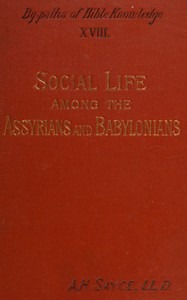
Social life among the Assyrians and Babylonians by A. H. Sayce

(10 User reviews)   3516
By Jacob Brown Posted on Dec 22, 2025
In Category - Space Opera
Sayce, A. H. (Archibald Henry), 1845-1933 Sayce, A. H. (Archibald Henry), 1845-1933
English
Hey, I just finished this fascinating book that pulls back the curtain on everyday life in ancient Mesopotamia. Forget just kings and battles—this book shows you what it was actually like to be a person living in Babylon or Nineveh. It’s all about family dinners, business deals, and neighborhood gossip from 3,000 years ago. The author uses real clay tablets, like ancient text messages, to reveal their laws, jokes, and even shopping lists. It completely changed how I picture these legendary empires. If you've ever wondered about the real people behind the epic stories, this is your backstage pass.
Share

Read "Social life among the Assyrians and Babylonians by A. H. Sayce" Online

This book is available in the public domain. Start reading the digital edition below.

START READING FULL BOOK
Instant Access    Mobile Friendly

Book Preview

A short preview of the book’s content is shown below to give you an idea of its style and themes.

the Tigris and Euphrates explain and illustrate the prophet’s words. Chaldea or Babylonia—for the two names are used synonymously—was the alluvial plain shut in between the two great rivers of Western Asia, and extended southwards from a point where they almost touched one another to the marshes at the head of the Persian Gulf, where they flowed into the sea. Northwards came the land of Assyria. It was originally the district which surrounded the ancient capital of Asshur, alluded to in the second chapter of Genesis[2], built on the western bank of the Tigris. Still further to the north were the later capitals, Calah and Nineveh, between which stood Resen or Res-eni, ‘the head of the fountain[3].’ The country of Assyria differed essentially from the country of Babylonia, and this difference exercised an influence upon the character of the populations which dwelt in them. Assyria was a land of limestone hills and thick forests, and was watered by the Tigris and its affluents, which cut their way through channels of rock. Babylonia, on the other hand, was flat and marshy; its soil was rich and fertile, but the rivers and streams that intersected it could be prevented from flooding the country only by means of a carefully organized system of canals. The silt which was carried down to the sea was continually adding to the land, and causing the shores of the Persian Gulf to advance southwards; cities which stood on the sea-coast in the early days of Babylonian history are now left far inland. The district adjoining the sea, however, was distinguished from the rest of Babylonia by the great salt-marshes which covered it. It was accordingly known as the land of Marratu, or ‘the salt-marshes,’ a name which appears in the Old Testament under the form of Merathaim[4]. In its midst rose the ancestral city of Merodach-baladan, whose ambassadors were shown by Hezekiah all the treasures of the Jewish monarchy. Merodach-baladan was a Chaldean. The Chaldeans, or Kaldâ, as they are called on the monuments, were a tribe which inhabited the salt-marshes, and we first hear of them in the ninth century before our era. Whether they belonged to the same Semitic race as the inhabitants of Babylon we do not know. But under Merodach-baladan they became famous in the Eastern world. Merodach-baladan made himself King of all Babylonia, and the Chaldeans became so integral and important an element in the population as henceforth to give it their name. From this time forward ‘Babylonian’ and ‘Chaldean’ became interchangeable terms. The Babylonian race was by no means pure. The original inhabitants of the country had been the Accadians, or Sumerians, who spoke an agglutinative language like that of the modern Finns or Turks, and had been the authors of the cuneiform system of writing and of the culture of early Babylonia. They occupied both Accad, the northern division of Babylonia, and Sumer, or Shinar, its southern division. In Accad, however, they were subjected at an early epoch to the domination of Semitic tribes, whose first home had been in Arabia; in Sumer they held their ground for a longer period, and it is probable that the Semite did not succeed in superseding them in this part of the country until a comparatively recent time. The Semites of Babylonia were closely allied both in race and language to the Hebrews. It was from Ur of the Chaldees, now represented by the mounds of Mugheir, that Abraham had migrated, and the other cities of Babylonia must have been largely occupied by traders and settlers of the Semitic race. Shortly after the...

This is a limited preview. Download the book to read the full content.

This isn't a story about one hero or a single event. Instead, A.H. Sayce acts like a detective, sifting through thousands of ancient clay tablets to piece together the daily routines of Assyrians and Babylonians. He shows us their world through their own words—from strict legal contracts and temple records to personal letters and school exercises.

The Story

There's no traditional plot. The 'story' is the reconstruction of a whole society. Sayce starts by explaining how we know anything about them (hint: it involves a lot of baked mud). Then, he walks us through their homes, their jobs, their family rules, and their religious beliefs. We learn about everything from marriage customs and inheritance laws to what they ate and how they punished thieves. It's a full, vibrant picture built from fragments of the past.

Why You Should Read It

This book makes history feel immediate. One minute you're reading about the grand Code of Hammurabi, and the next you're learning about a Babylonian kid getting in trouble at school or a merchant arguing over a copper delivery. It shatters the marble-statue image of ancient people and replaces it with relatable, complicated humans. You realize their worries about money, family, and fairness aren't so different from ours.

Final Verdict

Perfect for curious readers who love history but want to go deeper than politics and warfare. If you enjoy shows or books that explore 'how people lived' in other eras, you'll be hooked. It’s a bit like a time-travel documentary in book form. Just be ready for a lot of names and details—it’s packed with information, but it’s the good kind that makes you see the ancient world in a whole new light.


⚖️ Public Domain Notice

This digital edition is based on a public domain text. You are welcome to share this with anyone.

John Miller
1 year ago

Great digital experience compared to other versions.

Aiden Perez
9 months ago

Comprehensive and well-researched.

Betty Scott
3 months ago

Five stars!

Donald Lee
7 months ago

Fast paced, good book.

Richard Jones
2 months ago

Based on the summary, I decided to read it and the content flows smoothly from one chapter to the next. A valuable addition to my collection.

4.5
4.5 out of 5 (10 User reviews )

Add a Review

Your Rating *
There are no comments for this eBook.
You must log in to post a comment.
Log in


Related eBooks