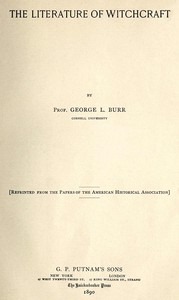
The literature of witchcraft by George Lincoln Burr

(7 User reviews)   4286
By Jacob Brown Posted on Dec 22, 2025
In Category - Space Opera
Burr, George Lincoln, 1857-1938 Burr, George Lincoln, 1857-1938
English
Ever wonder how the witch trials actually happened? This isn't a book about spells, but about the real paper trail of fear. George Lincoln Burr spent years digging through dusty European archives to find the original documents—the trial records, the letters, the pamphlets—that show how normal people got caught in a terrifying panic. It’s like watching a historical crime scene investigation, where the evidence reveals how gossip, superstition, and politics could turn into deadly accusations. If you think you know the story of the witch hunts, this collection shows you the receipts.
Share

Read "The literature of witchcraft by George Lincoln Burr" Online

This book is available in the public domain. Start reading the digital edition below.

START READING FULL BOOK
Instant Access    Mobile Friendly

Book Preview

A short preview of the book’s content is shown below to give you an idea of its style and themes.

South Sea island, the impulse and its outcome have been ever the same. Compared with the potent share of magic in human history, its literature is indeed but scant. Its choicest secrets have always gone by word of mouth. Yet it is a literature of all times and lands. From the clay volumes of Assyrian kings and the papyrus rolls of Egypt to the latest utterance of the spirits through Mr. Slade or of the mystic sages of the Orient through Mr. Sinnett, it is as perennial as human folly itself. Its faith may be feigned, its miracles sham; but magic itself is actual and universal. But witchcraft never was. It was but a shadow, a nightmare: the nightmare of a religion, the shadow of a dogma. Less than five centuries saw its birth, its vigor, its decay. And this birth, this vigor, this decay, were--to a degree perhaps else unknown in history--caused by and mirrored in a literature. Of that literature it has during the last decade been mine, as librarian of the President White Library at Cornell University, to aid in building up a collection. In the last few months I have had in hand the making ready of its catalogue for the press. My task is by no means finished, and I have much to learn; but it has seemed to me that even such a hurried survey of the literature of witchcraft as I may presume to attempt may not be without interest to the American Historical Association. And this the more, since no adequate bibliography of it has ever yet been published, and no historian has thoroughly known and exploited it. The literature of witchcraft, indeed, if under the name be included all the books which touch upon that dark subject, is something enormous. For at least four centuries no comprehensive work on theology, on philosophy, on history, on law, on medicine, on natural science, could wholly ignore it; and to lighter literature it afforded the most telling illustrations for the pulpit, the most absorbing gossip for the news-letter, the most edifying tales for the fireside. But the works devoted wholly or mainly to witchcraft are much fewer. Roundly and rudely estimated, this monographic literature includes perhaps a thousand or fifteen hundred titles.[1] The earliest of the books on witchcraft were written in the fourteenth and fifteenth centuries. Their writers were Dominicans of the Inquisition. Not that Brother Nicolas Eymeric or Brother Nicolas Jaquier or Brother John Vineti or Brother Jerome Visconti knew that he was writing on a new theme. On the contrary, they wrote to prove that this witchcraft whereof they spoke was as old as mankind. And they cited not only Thomas Aquinas and Vincent of Beauvais, but Isidore and Gregory and Cassian and Augustine, and, above all, the Bible,--nay, even Josephus and the ancient poets, Horace and Virgil and Ovid. Wherein, then, was it really new, and how did they come to write on it at all? Bear with me while I try very briefly to answer. Magic, in truth, the Christian Church had always known. Even the ancient faiths of Greece and Rome had, like all faiths, fought magic sternly; and, like all faiths, had counted magic much that was not so. But their polytheistic tolerance had reckoned it more a crime than a sin, and had not stigmatized as magical other faiths, save when, as in the case of Christianity, their own exclusiveness seemed to stamp their votaries as foes to the rest of mankind. Less indifferent was Christianity itself. Whatever the conceptions of her founder and of his...

This is a limited preview. Download the book to read the full content.

Forget broomsticks and pointy hats. George Lincoln Burr's work is a different kind of magic—it brings the original voices of the witch hunt era straight to you. He didn't write a narrative history; instead, he was a detective who collected the source material. The "story" here is told through the actual court documents, personal letters, and religious debates from the 15th to 18th centuries. You read the chilling questions asked by inquisitors, the desperate testimonies of the accused, and the arguments of the few brave souls who dared to say it was all nonsense.

Why You Should Read It

This book is powerful because it removes the filter. You're not getting a modern author's summary; you're facing the raw, often unsettling, words from the time. It makes the tragedy feel immediate. You see how legal procedures were twisted, how fear spread from village to village, and how complex figures like King James I were personally obsessed with the subject. It turns a vague historical horror into a clear, documented process. It’s humbling and a bit haunting.

Final Verdict

Perfect for history buffs, true crime readers, or anyone who loves primary sources. It’s not a light, cover-to-cover read—it’s a reference work to dip into. Think of it as the ultimate behind-the-scenes look at one of history's darkest chapters. If you want to understand the mechanics of mass hysteria, this is the foundational evidence. Keep it on your shelf next to your novels about Salem; it provides the sobering truth behind the fiction.


🏛️ Open Access

This work has been identified as being free of known copyright restrictions. Use this text in your own projects freely.

Patricia Miller
6 months ago

Without a doubt, the pacing is just right, keeping you engaged. Thanks for sharing this review.

Emma Sanchez
3 months ago

I had low expectations initially, however the clarity of the writing makes this accessible. A true masterpiece.

5
5 out of 5 (7 User reviews )

Add a Review

Your Rating *
There are no comments for this eBook.
You must log in to post a comment.
Log in


Related eBooks