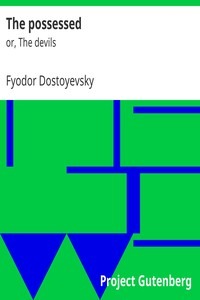
The possessed : or, The devils by Fyodor Dostoyevsky

(12 User reviews)   5671
By Jacob Brown Posted on Dec 22, 2025
In Category - Space Opera
Dostoyevsky, Fyodor, 1821-1881 Dostoyevsky, Fyodor, 1821-1881
English
If you've ever wondered what happens when revolutionary ideas meet small-town gossip, this is your book. Dostoyevsky drops a bomb of radical political theory into a sleepy Russian province and watches the pieces fly. It's about a group of young intellectuals whose grand plans for changing the world get tangled up in jealousy, madness, and one very suspicious fire. The real mystery isn't who starts the chaos, but how easily good intentions can turn into something monstrous. It's less of a whodunit and more of a 'why-on-earth-would-they-do-that'—and it's terrifyingly relevant.
Share

Read "The possessed : or, The devils by Fyodor Dostoyevsky" Online

This book is available in the public domain. Start reading the digital edition below.

START READING FULL BOOK
Instant Access    Mobile Friendly

Book Preview

A short preview of the book’s content is shown below to give you an idea of its style and themes.

form, if one may use such expressions, for he was a most excellent man. I am even inclined to suppose that towards the end he had been entirely forgotten everywhere; but still it cannot be said that his name had never been known. It is beyond question that he had at one time belonged to a certain distinguished constellation of celebrated leaders of the last generation, and at one time--though only for the briefest moment--his name was pronounced by many hasty persons of that day almost as though it were on a level with the names of Tchaadaev, of Byelinsky, of Granovsky, and of Herzen, who had only just begun to write abroad. But Stepan Trofimovitch's activity ceased almost at the moment it began, owing, so to say, to a "vortex of combined circumstances." And would you believe it? It turned out afterwards that there had been no "vortex" and even no "circumstances," at least in that connection. I only learned the other day to my intense amazement, though on the most unimpeachable authority, that Stepan Trofimovitch had lived among us in our province not as an "exile" as we were accustomed to believe, and had never even been under police supervision at all. Such is the force of imagination! All his life he sincerely believed that in certain spheres he was a constant cause of apprehension, that every step he took was watched and noted, and that each one of the three governors who succeeded one another during twenty years in our province came with special and uneasy ideas concerning him, which had, by higher powers, been impressed upon each before everything else, on receiving the appointment. Had anyone assured the honest man on the most irrefutable grounds that he had nothing to be afraid of, he would certainly have been offended. Yet Stepan Trofimovitch was a most intelligent and gifted man, even, so to say, a man of science, though indeed, in science... well, in fact he had not done such great things in science. I believe indeed he had done nothing at all. But that's very often the case, of course, with men of science among us in Russia. He came back from abroad and was brilliant in the capacity of lecturer at the university, towards the end of the forties. He only had time to deliver a few lectures, I believe they were about the Arabs; he maintained, too, a brilliant thesis on the political and Hanseatic importance of the German town Hanau, of which there was promise in the epoch between 1413 and 1428, and on the special and obscure reasons why that promise was never fulfilled. This dissertation was a cruel and skilful thrust at the Slavophils of the day, and at once made him numerous and irreconcilable enemies among them. Later on--after he had lost his post as lecturer, however--he published (by way of revenge, so to say, and to show them what a man they had lost) in a progressive monthly review, which translated Dickens and advocated the views of George Sand, the beginning of a very profound investigation into the causes, I believe, of the extraordinary moral nobility of certain knights at a certain epoch or something of that nature. Some lofty and exceptionally noble idea was maintained in it, anyway. It was said afterwards that the continuation was hurriedly forbidden and even that the progressive review had to suffer for having printed the first part. That may very well have been so, for what was not possible in those days? Though, in this case, it is more likely that there...

This is a limited preview. Download the book to read the full content.

The Story

A sleepy provincial town gets turned upside down when a crew of young, passionate radicals arrives. Led by the coldly intellectual Pyotr Verkhovensky, they want to tear down society and start fresh. Their ideas infect everyone around them, especially the troubled nobleman Nikolai Stavrogin, a man whose charm hides a dangerous emptiness. What begins as philosophical debate in drawing rooms quickly spirals into conspiracy, arson, and finally, murder. The book asks: when you try to play god with people's lives, who becomes the real devil?

Why You Should Read It

Forget dry political theory. Dostoyevsky makes ideas feel alive and dangerous. He shows how the desire to create a perfect world can justify truly awful actions. The characters aren't just symbols; they're vividly messed-up people. You have Stavrogin, who feels nothing, and Verkhovensky, who will do anything for his cause. Reading this feels like watching a slow-motion train wreck where every passenger thinks they're the conductor. It's a brutal, funny, and deeply uncomfortable look at the human heart.

Final Verdict

This is not a light read, but it's a powerful one. Perfect for anyone who loves stories about ideas with real consequences, or who enjoys complex, morally grey characters. If you liked the psychological tension of Crime and Punishment but wished it had more political chaos, this is your next book. Give yourself time with it—the first hundred pages are all setup—but once the fuse is lit, you won't be able to look away.


📜 License Information

This masterpiece is free from copyright limitations. Thank you for supporting open literature.

Lucas Jackson
2 years ago

Enjoyed every page.

Emily Lewis
1 year ago

I came across this while browsing and the author's voice is distinct and makes complex topics easy to digest. Don't hesitate to start reading.

Noah Rodriguez
10 months ago

Great reference material for my coursework.

Kimberly Jones
1 month ago

A must-have for anyone studying this subject.

Robert Lopez
1 year ago

This book was worth my time since the storytelling feels authentic and emotionally grounded. I would gladly recommend this title.
4.5
4.5 out of 5 (12 User reviews )

Add a Review

Your Rating *
There are no comments for this eBook.
You must log in to post a comment.
Log in


Related eBooks